From the Inaugural Race to the 20th Anniversary: Yuko Arimori on the Value of the Tokyo Marathon and “Running”
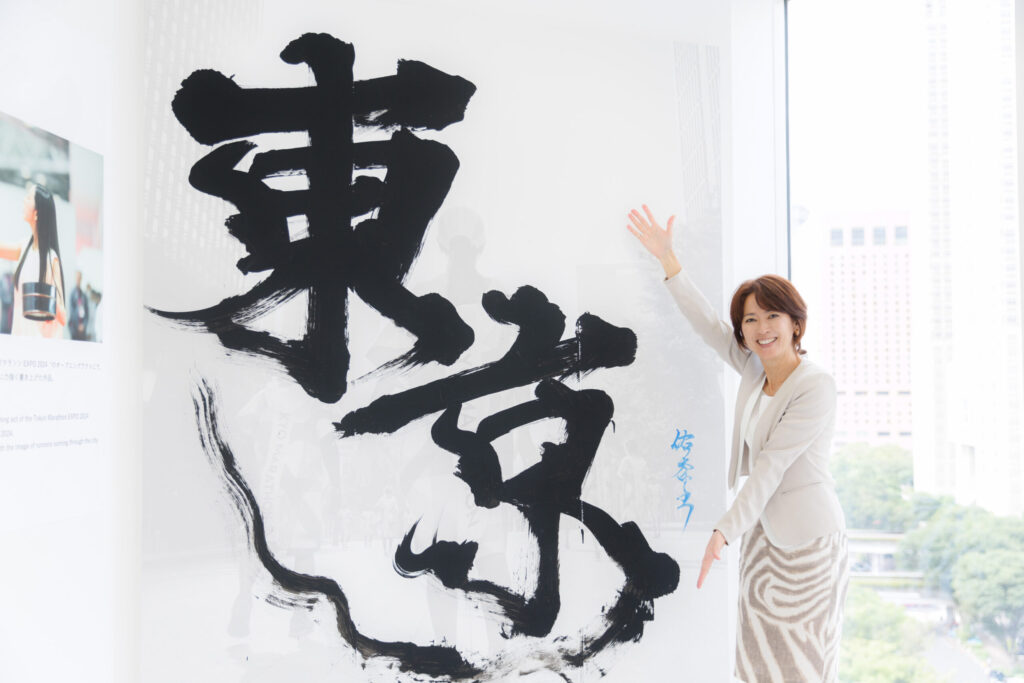
Interview Relay 3rd Run: Stories of “How the Tokyo Marathon Moved Your Life Forward.” This time, we spoke with Ms. Yuko Arimori, a silver medalist at the 1992 Barcelona Olympics and a bronze medalist at the 1996 Atlanta Olympics. As President of the Japan Association of Athletics Federations (JAAF) and a former Board Member of the Tokyo Marathon Foundation, she has dedicated herself to developing running culture in Japan.
In 2007, at the inaugural Tokyo Marathon, Ms. Arimori stood at the memorable start line for the final race of her professional career.
The event has continued to grow ever since, and in 2027, the Tokyo Marathon will celebrate its milestone 20th anniversary.
From participating as a runner in the very first race, to becoming a pivotal figure who supports the event and carries its legacy into the future—
Having closely witnessed and supported the evolution of the Tokyo Marathon over the years, Ms. Arimori shares her unique perspective on the event’s true value, her deep commitment to its charity initiatives, and how “running” has the power to drive both individuals and society forward.
The First Event Where I Realized Everyone Plays a Leading Role
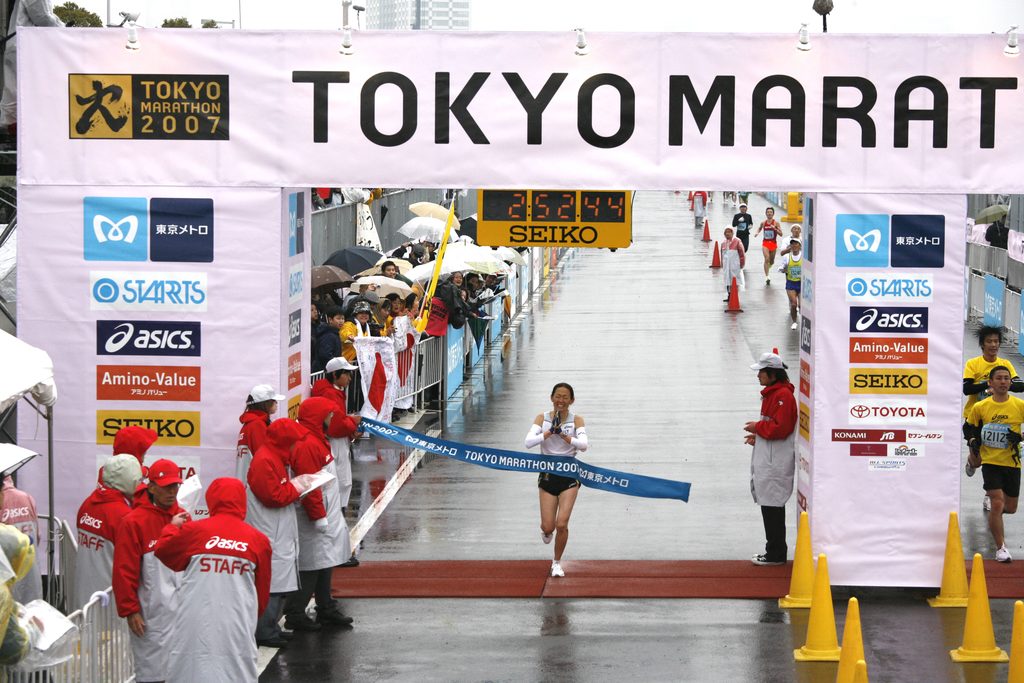
Photo: The inaugural Tokyo Marathon in 2007, which marked Ms. Arimori’s final race as a professional athlete.
—Could you tell us why you chose the inaugural Tokyo Marathon in 2007 as your final race before retirement?
I did have other options, such as the Osaka International Women’s Marathon and the Nagoya International Women’s Marathon, but both of those are crucial races for athletes aspiring to compete on the world stage. On the other hand, the Tokyo Marathon represented the dawn of a new history as its inaugural event, introducing a completely new style of race that welcomed a massive number of everyday runners. That is precisely why I decided to make the Tokyo Marathon my retirement race.
However—I wonder if people remember this (laughs)—I took a terrible fall around the 22km mark. My athlete bib ripped off, and my hands and legs were covered in blood. Even though it was meant to be my grand finale, I ended up causing so much worry and trouble for the organizers and staff.
—You managed to finish the race despite that accident. What were your overall impressions of the Tokyo Marathon as an event?
What left the biggest impression on me wasn’t the finish line, but the start.
It was a freezing day, with sleet falling from the sky. Yet, despite the harsh weather, the event officials and staff were out there making preparations without even wearing raincoats. Seeing them like that, it truly hit me for the first time: “This event is only made possible by the incredible support of so many people.”
During my competitive days, I took it for granted that I was participating as an elite athlete, and to be completely honest, I rarely had the chance to deeply appreciate the presence of the people working behind the scenes to support the races.
But when I actually ran the course, I felt an overwhelming sense of gratitude for the volunteers who stood in the freezing rain to support us, and the spectators who continuously cheered for us from the sidelines. I felt a profound connection—not just among the runners, but among everyone involved in the event, all uniting as one.
The Tokyo Marathon was the very first event that made me realize, “It’s not just the runners—everyone here plays a leading role.”
—We’ve heard that your insights back then actually led to the official race concept: “The Day We Unite.”
I actually had no idea (laughs).
At the time, I was told that the Tokyo Marathon was envisioned as “the Tokyo version of the TCS New York City Marathon.” Having actually taken part, I thought it was a truly fantastic event. At the same time, though, I couldn’t help but feel that it could use a stronger, more distinctive concept unique to this specific race.
Major international marathons all have a clear purpose behind their existence. The TCS New York City Marathon, for instance, has charity at its roots and evolved as an event that deeply connects people with society. That’s why I believed that having a compelling “why”—a shared purpose that people can genuinely resonate with—is what builds an event’s lasting value and ensures its long-term future.
Charity, in particular, possesses the power to bridge sports and society. So back then, I felt, “Since this is such a massive, impactful event, it would be wonderful if the Tokyo Marathon could more actively convey its own unique heart and values.”
I was truly delighted when I later learned that sharing those thoughts with Mr. Hayano, who was the PR Director at the time (and is now the CEO/Chairman of the Tokyo Marathon Foundation), eventually sparked the official race concept: “The Day We Unite.”
Charity Naturally Spreads Through the Power of Marathons
—How do you view the Tokyo Marathon’s current charity initiatives?
The Tokyo Marathon’s charity program has expanded year after year, and I believe it has served as a powerful catalyst for establishing a true culture of giving in Japan.
Back in 1996, I participated in a charity marathon in Cambodia and witnessed firsthand how sport encompasses so many essential elements capable of sparking real change in people and society. That experience inspired me to establish the NPO “Hearts of Gold,” and through it, I continue to support communities through sports to this day.
I had always hoped to see a genuine culture of charity spread across Japan through a major event like the Tokyo Marathon.
By integrating charity into the Tokyo Marathon, it offered runners a profound opportunity to discover a new meaning and joy in sports—realizing, “Through my running, I can actually give back to society.”
—Looking ahead, how do you hope the charity culture that expanded throughout the sports world—sparked by the Tokyo Marathon—will continue to grow?
Following the inception of the Tokyo Marathon, large-scale city marathons emerged all across Japan, including in Osaka, Kyoto, and Kobe. However, simply announcing “we are hosting a city marathon” is no longer enough to move runners’ hearts today.
Each event must have a clear “why”—a distinct concept and a value unique to that race. Only when an event embodies the unique charm of its host city and conveys a meaningful message to society can it truly resonate with people and become deeply loved over time.
For the Tokyo Marathon, I believe charity represents one of those core, defining values.
The beauty of a marathon lies in its universal accessibility—anyone, from young children to seniors, can take part and express their personal goals and messages through the act of running. There is truly no other medium that allows so many people to naturally connect with society.
Because of this, I firmly believe marathons possess an inherent power to foster charity naturally. As these initiatives take deeper root, the act of “running” will directly tie to social contribution, elevating the societal value of marathons themselves even higher.
My hope is that the Tokyo Marathon will continue to pioneer charity culture and keep demonstrating to the world that “running” has the ultimate power to unite people and society.
How “Running” Moved My Life Forward
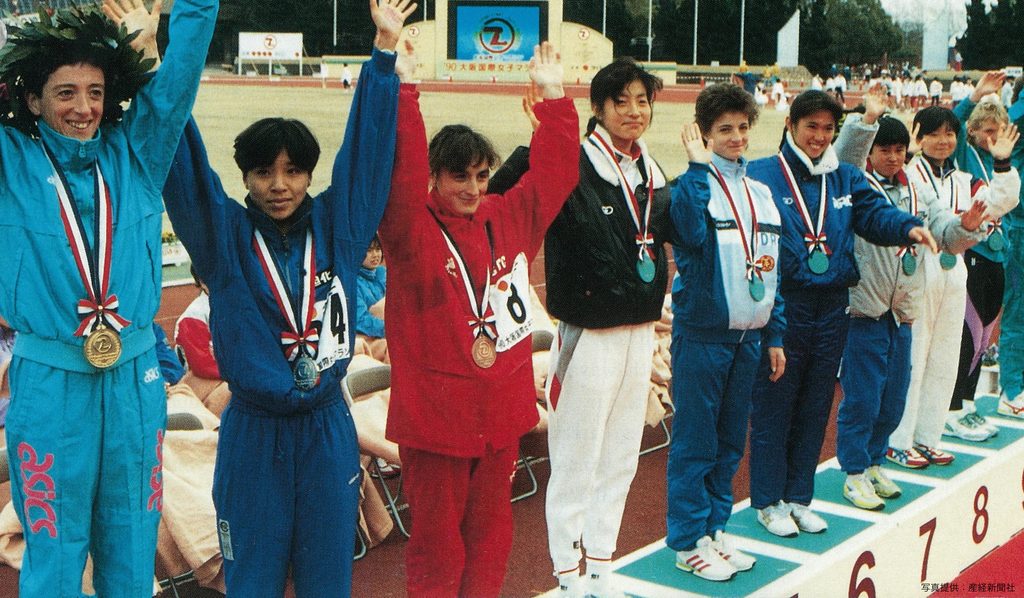
Ms. Yuko Arimori at the 9th Osaka International Ladies Marathon, held on January 28, 1990, where she finished sixth in 2:32:51, setting the Japanese best for a marathon debut at the time.
Photo courtesy of The Sankei Shimbun
—For you personally, what was a defining challenge or event that significantly moved your life forward?
The pivotal moment that transformed my life as a marathon runner was the 1990 Osaka International Women’s Marathon. It was my debut marathon, and I set what was then the Japanese women’s debut record. The following year, I broke the national record, and back then my catchphrase was, “If I won Osaka, I can reach the world.” In that sense, Osaka is an irreplaceable race that paved the way for my entire career as a runner.
—How has “running” moved your life, and what has it brought to you?
Because I was able to achieve results through running, I was empowered to build a life that is authentically my own.
People often ask me, “You must really love running, right?” But the truth is, I don’t (laughs). I have never run because I liked it or hated it.
To me, “running” is a means of living. By running, I create the very things that sustain my life and discover new dimensions of who I am. That is why I run. It is no different from any other career. But having “running” as my life’s work makes me feel truly fortunate. That feeling has never changed.
—So many people have drawn courage from watching you run. On the flip side, was there an instance where seeing someone else’s challenge inspired you to take a new step forward?
During my active days as a competitive athlete, I focused almost entirely on myself rather than on others. However, back when I was striving to reach the Atlanta Olympics, I received a postcard from Ms. Sachiko Yamashita. She wrote, “I’m begging you, please stand on that starting line. Give it everything you’ve got.”
Even though Ms. Yamashita herself was aiming for the Olympics, she supported my challenge with all her heart. Her words taught me what truly matters as a human being and showed me a deep bond of friendship that transcended rivalry. Even today, those words remain a powerful force pushing me forward from behind.
The Importance of Supporting and Being Supported

—How has your perspective on the value of “running” evolved from your days as a competitive athlete to your current role supporting others in their challenges?
Charity work through running is certainly one example, but today I believe that “running” can—and should—mean different things to different people. I feel my true role now is to support those who are giving their all to a challenge, so they can unleash their full potential.
I still run a bit myself, but whenever I look at all the runners out there, I catch myself thinking, “It’s not even their day job, so how can they push themselves this hard?” (laughs). That is precisely why I want to cheer for their efforts with everything I’ve got. I want to convey that encouraging message—”You’re doing great, you can keep going!”—to as many people as possible. To me, that is the most meaningful thing I can do right now.
At races, I sometimes spend hours on end shouting words of encouragement. Honestly, it can be harder than running itself (laughs)! But when I see an exhausted runner’s expression completely transform the moment I call out to them, watching them dig deep and take another step forward—that gives me immense strength in return.
—Come to think of it, I can’t even remember the last time someone personally cheered for me (laughs).
Exactly! The older we get, the easier it is to forget how wonderful it is to cheer for someone—and to be cheered for yourself. But a marathon is a sport that gently reminds us of that very truth.
A simple “You’ve got this!” lets you feel seen, valued, and cheered on in life, giving you the strength to keep moving forward. And when you witness how much energy that single phrase brings to someone else, it revitalizes the person cheering just as much.
A Growing Chain of Shared Joy

—We certainly hope you’ll be out there cheering with everything you’ve got for the 20th anniversary of the Tokyo Marathon! Looking back from the very first event, how do you feel the race has evolved over the years?
I feel that a “chain of shared joy”—where one’s own happiness connects to and creates joy for someone else—has continued to expand.
We see an increasing number of international participants, with people uniting across borders and regions with a shared passion to co-create this event. Moreover, the circle of charity has steadily widened, allowing the race to mature into an event where the simple act of “running” directly connects to supporting others and giving back to society.
With every passing edition, the Tokyo Marathon has amplified its power to bring together person to person, and person to society.
—As the Tokyo Marathon reaches its 20th edition, what kind of impact do you think it has made on Japan’s overall running culture?
First, it dramatically expanded what a mass-participation marathon in a major global metropolis could achieve.
Above all, I believe it fostered a culture where everyone involved—not just the runners, but the volunteers, race staff, and spectators lining the streets—comes together as one to build the event side by side.
When it began, almost no sports event shone such a bright spotlight on its volunteers. As volunteer pride and engagement grew, runners also came to deeply appreciate, “Look at how many incredible number of people are supporting me as I run.” That cultural shift was monumental.
Everyone plays a leading role, and everyone is connected.
To me, that is the core value the Tokyo Marathon has lovingly nurtured through its 20th anniversary—and it remains an invaluable legacy gifted to Japan’s running culture.
Feel the Energy Created at the Tokyo Marathon

—What are your hopes and expectations for the Tokyo Marathon 2027 as it celebrates its landmark 20th anniversary?
I hope this 20th anniversary edition will be a moment where everyone involved can genuinely feel once again, “I am so glad we started a marathon here in Tokyo.”
And I want it to be an opportunity for all of us to reaffirm that this is an event where everyone—not just the runners, but the volunteers, the spectators cheering along the streets, and the staff working behind the scenes—plays a leading role and shares in that collective joy.
The 20th anniversary is not the finish line; it is a brand-new beginning. I hope the Tokyo Marathon continues carrying the core values it has lovingly cultivated into the future, remaining an event that makes people around the globe think, “There is something truly special about Tokyo,” and “That is why I want to run Tokyo.”
—Lastly, do you have a message for all the runners, volunteers, and supporters taking part in the Tokyo Marathon 2027?
For me, the Tokyo Marathon was the last race of my competitive career and a pivotal turning point that profoundly moved my life forward.
That is why I wholeheartedly believe the Tokyo Marathon has the power to move people’s lives forward.
Whether you are running, supporting behind the scenes, or cheering from the sidelines, everyone present can empower someone else from their own place. One person’s joy sparks joy in another, and that shared joy gives birth to brand-new challenges. To me, that is the true magic of the Tokyo Marathon.
So whether you participate as a runner, a volunteer, or a supporter along the course, I hope you will come and experience the incredible energy born at the Tokyo Marathon in person.
I would be deeply honored if that day serves as an opportunity for everyone to take a new step forward.

-

TCS New York City Marathon® RD Ted Metellus World Marathon Voices A Global Perspective on the Tokyo Marathon
MORE -

Creating the Day We “Run Through the Heart of Tokyo” — Bringing the Tokyo Marathon to Life with the Tokyo Metropolitan Police Department —
MORE -
World Marathon Voices A Global Perspective on the Tokyo Marathon The Bank of America Chicago Marathon Race Director Carey Pinkowski
MORE -

20 Milestones of Connection between the Neighborhood and Its People – Tokyo Marathon Seen from Ginza
MORE -
Supporting Neighborhoods Edition Connecting Runners and the City: 20 Editions of the Tokyo Marathon Seen from Nihonbashi
MORE