Supporting Neighborhoods Edition Connecting Runners and the City: 20 Editions of the Tokyo Marathon Seen from Nihonbashi
Interview Relay 3rd Run: Stories of “How the Tokyo Marathon Moved Your Life Forward.” This time, for our “Supporting Neighborhoods Edition,” we spotlight Nihonbashi, one of the most iconic districts along the Tokyo Marathon course.
Nihonbashi is a historic neighborhood that has flourished since the Edo period as the starting point of the Five Routes (Gokaido). Since the inaugural event in 2007, it is also a district that has warmly welcomed, watched over, and supported the Tokyo Marathon.
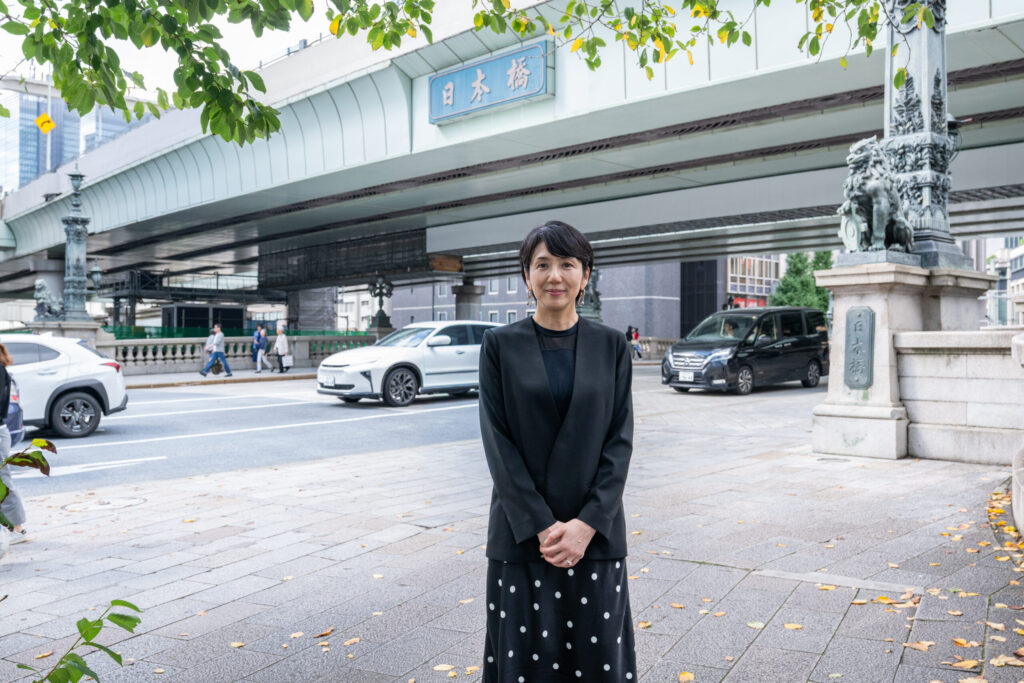
Ahead of the milestone 20th edition, Tokyo Marathon 2027, we spoke with Ms. Miyuki Fukushima, Vice President and Acting President of the “Famous Bridge Nihonbashi” Preservation Association. We reflected on the shared journey of the Tokyo Marathon and Nihonbashi, the community’s heartfelt passion for welcoming runners, and the future ahead for both the marathon and this historic neighborhood. The Association continues its dedicated work to safeguard the landmark bridge and pass the district’s rich charm down to future generations.
Restoring the Blue Sky Over Nihonbashi
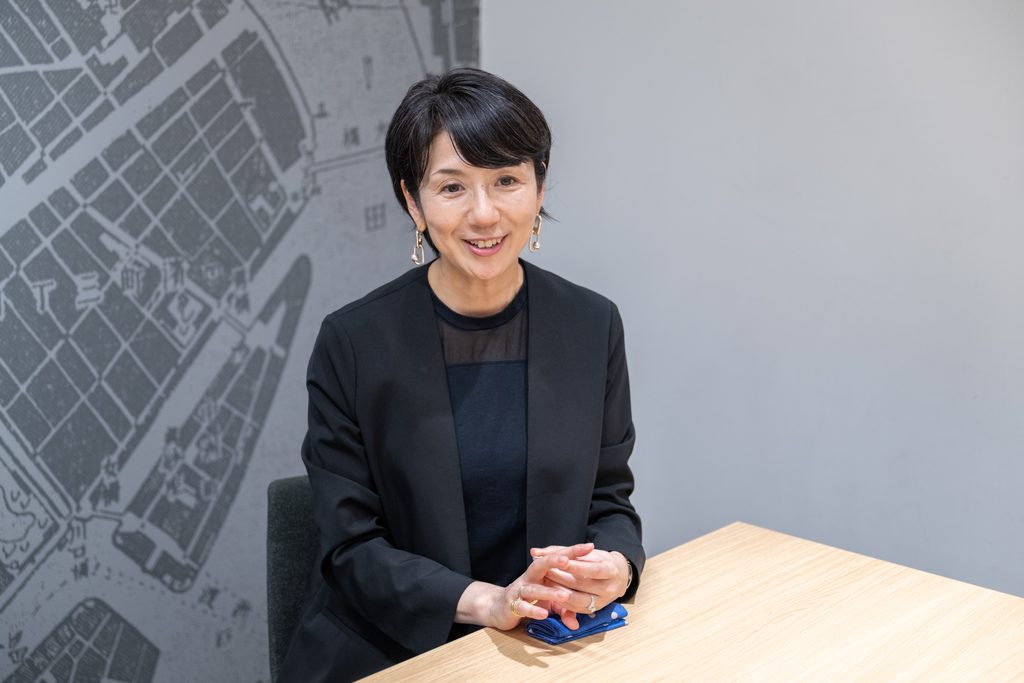
——First, could you tell us about your connection to Nihonbashi?
I joined Mitsukoshi in 1994, and since 2004, I have also been serving in the secretariat of the “Famous Bridge Nihonbashi” Preservation Association. I have welcomed the Tokyo Marathon here in the Nihonbashi district since its inaugural event in 2007.
Until 2016, the marathon course simply passed through the Nihonbashi area, but after a course change in 2017, runners now cross the Nihonbashi Bridge itself, which is designated as a National Important Cultural Property. I’ve been working in Nihonbashi ever since I joined the company (laughs).
——What kind of activities does the “Famous Bridge Nihonbashi” Preservation Association do?
Nihonbashi is a bridge designated as a National Important Cultural Property. One of our association’s main goals is to move the Metropolitan Expressway, which currently runs directly above the bridge, underground and to remove the overpass. Under the current plan, the underground route will be completed in fiscal 2035, and the overpass will be removed in fiscal 2040. Reclaiming the blue sky over Nihonbashi has long been a sincere wish of the local community.
Nihonbashi is the emotional heart of this community and the symbol of our district. It feels like a real shame that the expressway covers the sky above it, leaving the bridge in the shadows. We want to pass down a Nihonbashi with a clear blue sky to our children and grandchildren. And inl 2040, we definitely want the runners to experience crossing Nihonbashi under that beautiful blue sky, too.
——The expressway above Nihonbashi opened in 1963. Were there any voices of opposition back then?
Actually, I’ve heard that there was almost no opposition at the time. It was an era when the whole country was pushing forward with urban infrastructure development. Many people were seeing an expressway for the first time, and they seemed excited, anticipating a near-future world like something out of Astro Boy.
However, once the expressway was built, the scenery of Nihonbashi changed drastically. Afterward, the “Famous Bridge Nihonbashi” Preservation Association was established in 1968 to foster local development while preserving this beautiful bridge for future generations.
The Greatest Charm of Nihonbashi is “Human Connection”
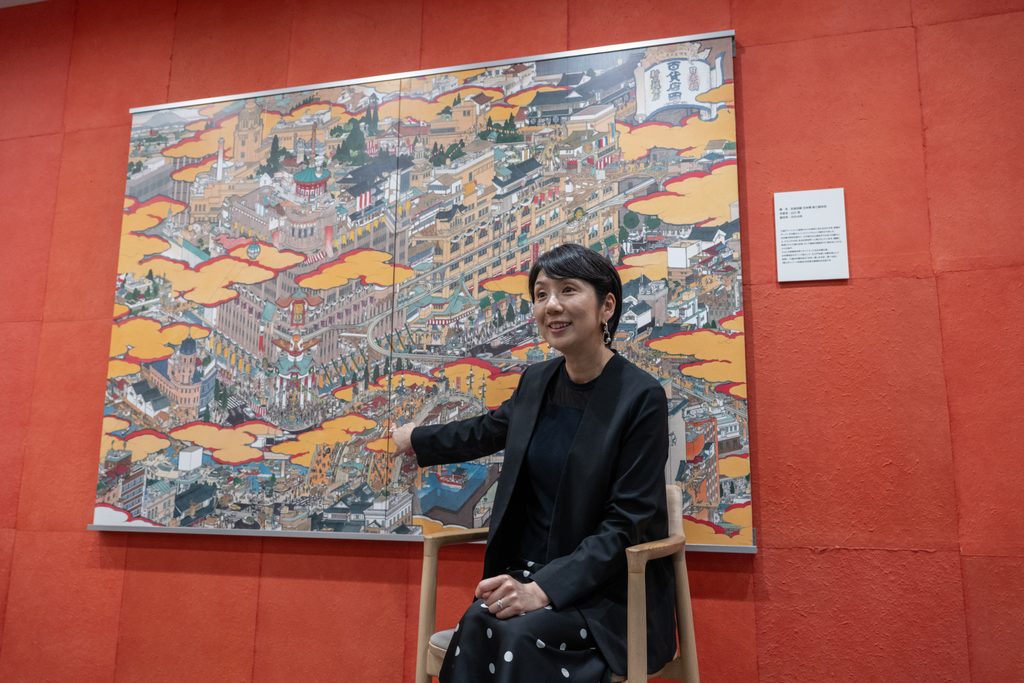
——So there is that kind of history behind it. With that in mind, could you tell us once again about the unique characteristics and appeal of Nihonbashi?
Nihonbashi is a district with a rich history and many tourist attractions, and it thrived as an economic hub. However, when people ask, “What exactly is there to see in Nihonbashi?”, its charm can be harder to define at a glance than places like Asakusa.
I believe that Nihonbashi’s greatest appeal lies in the “connections between people.” Of course, the iconic bridge itself is a huge attraction as well.
——Are there any memorable events or episodes that symbolize these “connections between people” in Nihonbashi?
Symbolically, the bridge itself serves as a border between different local guardian deities (Ujigami). If you look from the Zero Milestone (the starting point of Japan’s national highway network) in the center of the bridge, the Mitsukoshi department store side falls under the parish of the Kanda Shrine, while the Takashimaya and Tokyo Station side belong to the Hie Shrine parish.
The Kanda Matsuri and the Sanno Matsuri, two of the most prominent festivals of Edo (old Tokyo), have alternated every year since the Edo period. During these festivals, portable shrines (mikoshi) parade energetically back and forth across the streets of Nihonbashi.
Through these festivals, the people of the district have long supported one another—regardless of age, occupation, hometown, or the type of business they run. Because Nihonbashi has carried this culture of mutual support alongside its festivals since the Edo period, I believe you can feel these “connections between people” so strongly here.
The Atmosphere of the City Changes Completely on Race Day
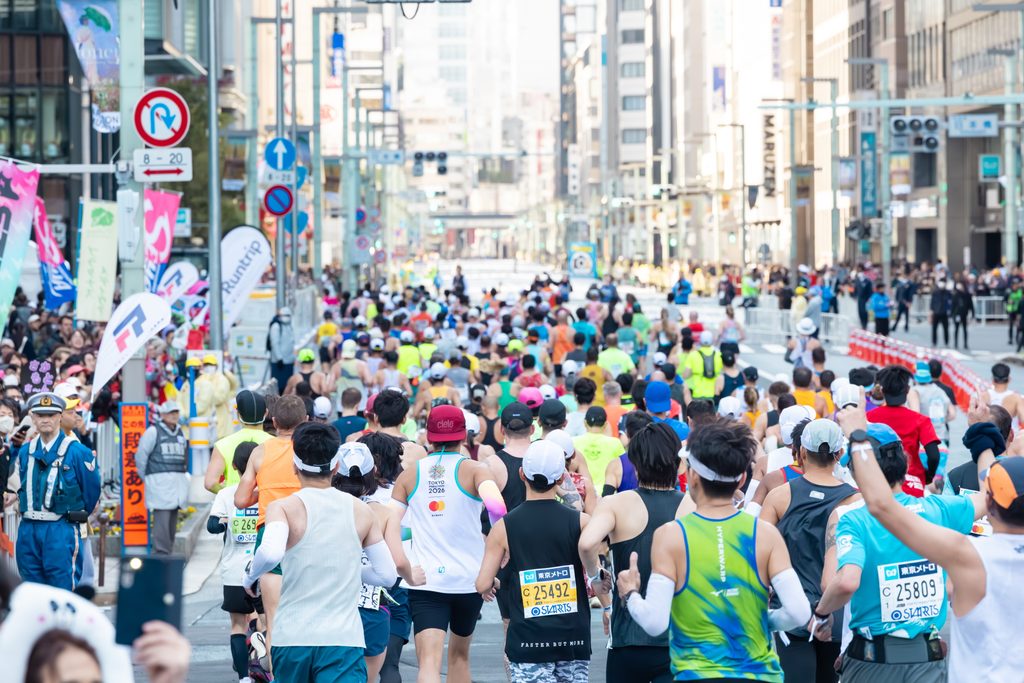
——Now, let’s talk about the relationship between Nihonbashi and the Tokyo Marathon. On the current course, runners pass through Nihonbashi twice, on both the outbound and return legs. As a district that has welcomed the Tokyo Marathon and its runners since the inaugural event, what have you prioritized or cherished most?
First, we value keeping the district beautiful. This isn’t just for the Tokyo Marathon; keeping our streets clean is deeply rooted in the daily life of Nihonbashi.
We want everyone who visits to become a fan of Nihonbashi. If people involved in the event come back to visit us on another day, we want them to think, “Nihonbashi really is a wonderful place.”
Moreover, Nihonbashi is a bustling business district with a large daytime population of office workers. We want those who have recently started working here to develop an affection for this area, too. I am always thinking about how we can create an environment where they know about and want to support every single event held in Nihonbashi.
——Do you feel that the atmosphere of the district differs from usual on race day or as the event approaches?
For us in Nihonbashi, the Tokyo Marathon isn’t so much a sudden event of “The Tokyo Marathon is coming!” Rather, it feels more like, “It’s Tokyo Marathon season,” or “It’s already that time of year.” It has truly become a cherished seasonal tradition that marks the changing of the seasons for us.
Early on race day, runners in brightly colored gear dash through the crisp, clear air. The district’s look changes dramatically compared to everyday Nihonbashi.
Normally, Nihonbashi has an orderly cityscape and is home to five National Important Cultural Properties. So, compared to places like Shinjuku, it can feel slightly formal or stiff. However, on race day, the vibe in the air feels completely different. After all, you hardly see anyone walking around in a business suit! (laughs)
Every year, huge crowds gather to cheer around the Mitsukoshi-mae area and the Nihonbashi bridge itself. You can really feel the swelling excitement and a strong sense of unity radiating from the sidelines. Seeing everyone cheering with such genuine joy, it always makes me so happy that they choose to come to Nihonbashi to experience it.
Additionally, along the sidewalks of Chuo-dori Avenue, flower beds are jointly managed by the Kyobashi and Nihonbashi communities. These flowers are planted to welcome visitors, tourists, and, of course, the runners, so I truly hope people enjoy them. We replant the beds three times a year to match the seasons, ensuring that gorgeous flowers are in full bloom right in time for the Tokyo Marathon.
Nihonbashi’s “Iki” Spirit: Welcoming New People and Cultures
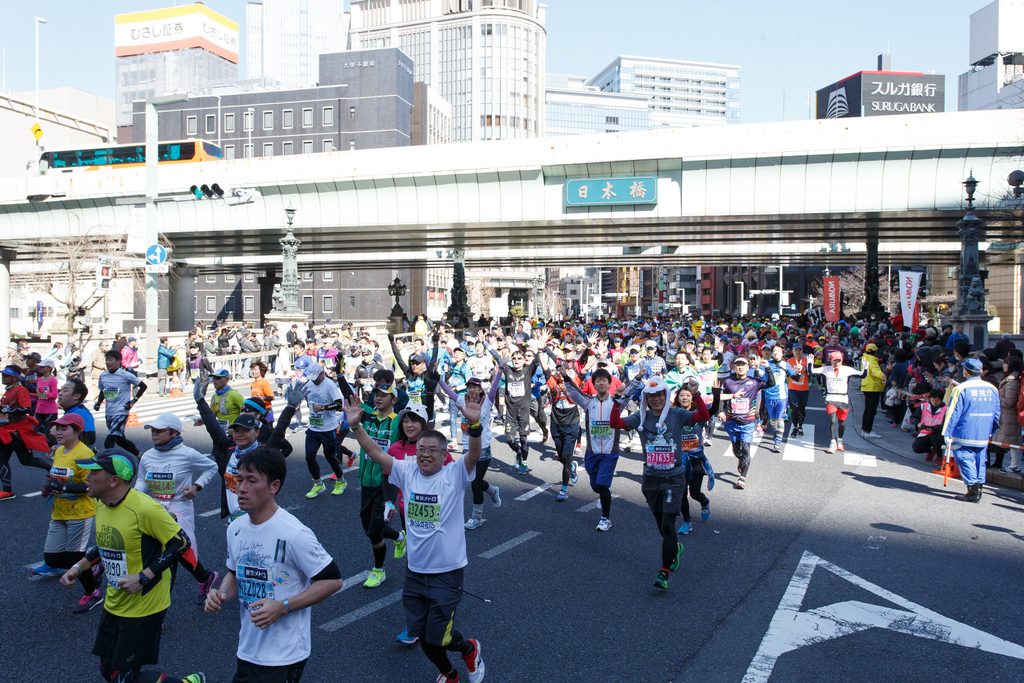
——As someone who has watched the Tokyo Marathon from Nihonbashi for many years, is there a memorable moment where you felt that the marathon sparked a new movement or change?
What stands out most in my memory is an event concerning the marathon course itself. In the early years, the course passed through the Nihonbashi area, but runners did not actually cross the bridge itself.
Then, the previous head of Eitaro Sohonpo, a long-established Japanese confectionery shop in Nihonbashi, reached out to me, saying, “Runners definitely ought to cross over Nihonbashi bridge, too! Let’s go meet the Governor of Tokyo together.” So we actually went to submit a petition. Although we couldn’t meet the Governor directly due to scheduling conflicts, we were able to convey our request to the Vice Governor.
Of course, we didn’t expect our request to be granted so easily, so for my part, I felt that just making the trip to petition was meaningful in itself. But a few years later, the course was indeed changed to cross the Nihonbashi bridge. Everyone at Eitaro Sohonpo was absolutely thrilled, too.
——So your actions alongside the head of Eitaro Sohonpo served as one of the catalysts that set a new relationship between the Tokyo Marathon and Nihonbashi into motion. Today, many runners participate from abroad. How do you feel when you see runners from all over the world dashing through Nihonbashi?
A growing number of international tourists have been visiting Nihonbashi as well. Even if it’s just passing through during the Tokyo Marathon, I hope runners can experience the essence of Nihonbashi and fall in love with this district.
Nihonbashi has been a town where merchant culture flourished since the Edo period. As a result, there is no hesitation here in welcoming new people or cultures. That spirit remains deeply rooted in the district’s DNA today.
In Nihonbashi, there is an unspoken tradition of everyone working together when something benefits the community.
This spirit is reflected in the way local residents embrace the arrival of many overseas visitors and the energy they bring to the entire neighborhood as something truly iki.
I am truly delighted that so many people, including runners, come to visit us from abroad.
Because of this cultural background, even back during the inaugural event in 2007, there was a natural openness to welcoming the Tokyo Marathon. Nihonbashi possesses a “barrier-free” culture that creates no walls between people or cultures. The prevailing attitude was: if it brings excitement to the whole town, let’s all prepare and welcome them together.
——What aspects of Nihonbashi’s charm would you like runners and spectators from Japan and around the world to experience and enjoy?
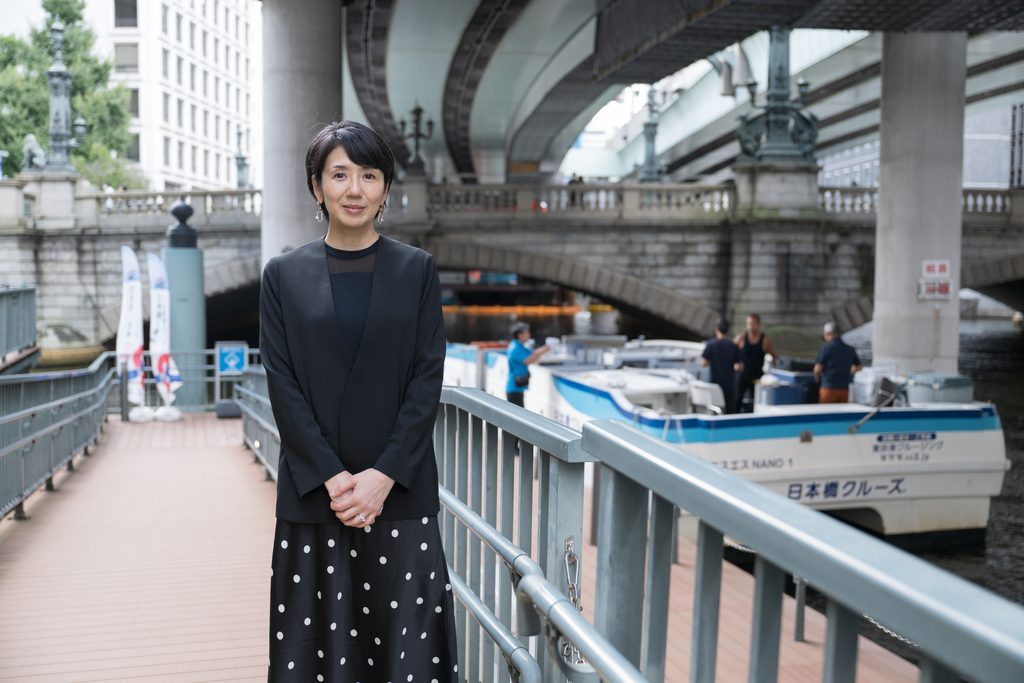
Right at the foot of the Nihonbashi Bridge, there is a boat dock. While I would be happy if people simply ran across Nihonbashi and admired the cityscape, after the marathon, I would love for them to board a boat from Nihonbashi and experience Tokyo from the river.
Just like the roads runners race on, the rivers are “highways” of their own. That, too, is one of Tokyo’s greatest charms. Viewing Tokyo and Nihonbashi from the water offers a completely different perspective than seeing them from land.
From the quiet water, you can catch sight of the historic stone walls of Edo Castle, feeling as though you’ve traveled back in time. Heading toward the Kanda River, you’ll see traditional yakatabune houseboat piers, giving you a taste of the common folk culture that has continued since the Edo period. Furthermore, when you reach the Sumida River, a cityscape that evokes Tokyo’s future unfolds before you. I believe people will thoroughly enjoy discovering a side of Tokyo that offers a delightfully different flavor from the marathon course.
Watching the Ever-Changing Nihonbashi Together with the Runners
——Tokyo Marathon 2027 will mark the milestone 20th edition. Looking back over its history, how do you feel the Tokyo Marathon has developed?
Looking back over the past 20 years, the Nihonbashi district itself has transformed tremendously. I feel that the Tokyo Marathon has walked hand-in-hand with these changes in our city.
Even as the cityscape evolves, the heartfelt dedication of the people connected to Nihonbashi remains unchanged. I believe the same is true for the Tokyo Marathon. It is precisely because of the unwavering passion of every individual involved that the event has continued for 20 editions.
——What kind of relationship would you like Nihonbashi and the Tokyo Marathon to build moving forward?
At the “Famous Bridge Nihonbashi” Preservation Association, we spent many years campaigning to have the return leg of the Hakone Ekiden pass through Nihonbashi. As a result, starting with the 75th edition in 1999, the current route was established—where runners cross the Nihonbashi bridge in Section 10 on their way to the finish line in Otemachi. Today, our association continues to support the race through roadside security and other efforts.
Behind those efforts was our earnest desire to have as many people as possible get to know “the Nihonbashi of today.” I am deeply gratified to see that same desire being fulfilled through the Tokyo Marathon as well.
Moving forward, redevelopment will progress in Nihonbashi, and the cityscape will undergo major changes. At the same time, we must preserve the Nihonbashi bridge as a symbol of our community and pass it down to future generations.
I would be delighted if runners across generations get to know Nihonbashi through the Tokyo Marathon and continue to witness the changing townscape alongside us—including the day when we can all look up at a clear blue sky from the bridge. I hope to see all kinds of synergies continue to grow between the Tokyo Marathon and Nihonbashi.
Above all, I hope for a relationship where the host community welcoming the runners and the event organizers remain united in heart, continuing to support the marathon together.
——How will Nihonbashi evolve as a district in the future?
Currently, a major project is underway to move the Metropolitan Expressway underground. In line with this, urban planning that makes the most of the bridge and the river is progressing, with urban redevelopment projects planned for five districts along the Nihonbashi River. As the riverfront scenery changes significantly, new ways to enjoy the Tokyo Marathon may emerge, such as spectating from these new waterfront spaces.
Over the past 20 years, redevelopment has brought new commercial complexes like COREDO Muromachi, dramatically transforming the district’s atmosphere. Because Nihonbashi is a financial center, it used to feel somewhat quiet and dark on weekends and evenings when pedestrian traffic thinned out. Today, however, it has become a vibrant neighborhood visited by many people, including the younger generation.
——As a district that continues to welcome the Tokyo Marathon, what kind of place do you hope Nihonbashi will be in the future?
Even as the cityscape changes, I hope the DNA of Nihonbashi will endure. That DNA is the spirit of caring deeply for our district and passing that love down to the next generation.
Feel the Encouragement from Nihonbashi’s “Animals” as Well
——On behalf of Nihonbashi, do you have a message for the runners participating in the Tokyo Marathon 2027?
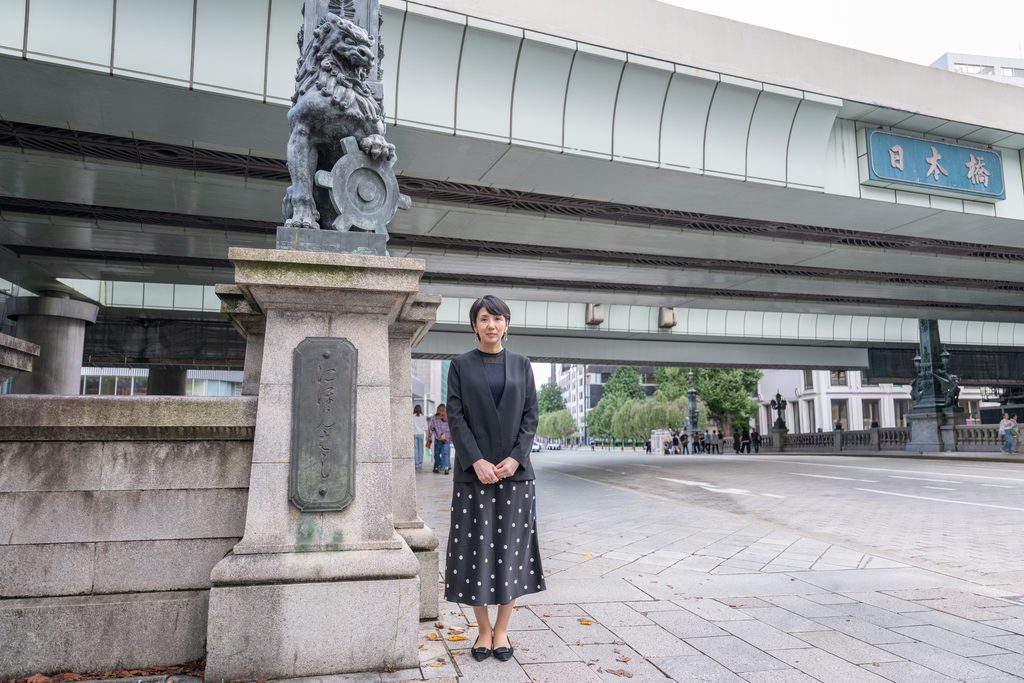
In Nihonbashi, it’s not just us humans who welcome the runners every year—our “animals” do, too. At the main entrance of Nihonbashi Mitsukoshi Main Store, there are two lion statues, while the Nihonbashi bridge itself features statues of Kirin (mythical creature) and lions.
In 1904, Nihonbashi Mitsukoshi Main Store issued Japan’s very first “Department Store Declaration.” Later, the general manager at the time, Osuke Hibi, inspected Europe and the United States, and decided to install lion statues at Mitsukoshi modeled after the famous lions in London’s Trafalgar Square.
Ever since the main building was completed in 1914, those two lion statues have continued to greet visitors at the main entrance, and they remain beloved symbols of Mitsukoshi to this day.
Meanwhile, the lion statues at the four corners of the Nihonbashi bridge hold the Tokyo City emblem like a shield. They are said to symbolize the protection and dignity city of Tokyo.
The Kirin statues in the center of the bridge symbolize the prosperity of Tokyo City. A unique feature of the Nihonbashi Kirin is that they were given dorsal fins, which typical mythical Kirin do not have.
I truly hope all the runners can feel the cheering and support from these “animals” of Nihonbashi as they race past.
——Finally, what does the Tokyo Marathon mean to you?
In Nihonbashi, we have major community-wide events throughout the seasons: the Hakone Ekiden, the “Famous Bridge Nihonbashi” Bridge Washing ceremony, the Nihonbashi-Kyobashi Festival parade, and the Tokyo Marathon.
Just like the Hakone Ekiden relay, the Tokyo Marathon is a vital event that welcomes countless people every year and brings our entire community together. For Nihonbashi, it is an event we want to continue to cherish in the future.

-

TCS New York City Marathon® RD Ted Metellus World Marathon Voices A Global Perspective on the Tokyo Marathon
MORE -

Creating the Day We “Run Through the Heart of Tokyo” — Bringing the Tokyo Marathon to Life with the Tokyo Metropolitan Police Department —
MORE -
World Marathon Voices A Global Perspective on the Tokyo Marathon The Bank of America Chicago Marathon Race Director Carey Pinkowski
MORE -

20 Milestones of Connection between the Neighborhood and Its People – Tokyo Marathon Seen from Ginza
MORE -
World Marathon Voices A Global Perspective on the Tokyo Marathon The TCS Sydney Marathon Race Director Wayne Larden
MORE