
Interview Relay
Stories — Connected Through the Tokyo Marathon
“Connecting through Running” ~A Bond of Trust between Coach and Runner, Born from the Tokyo Marathon~
Interview Relay 2nd RUN: Stories of “Connections Between People” Born Through the Tokyo Marathon
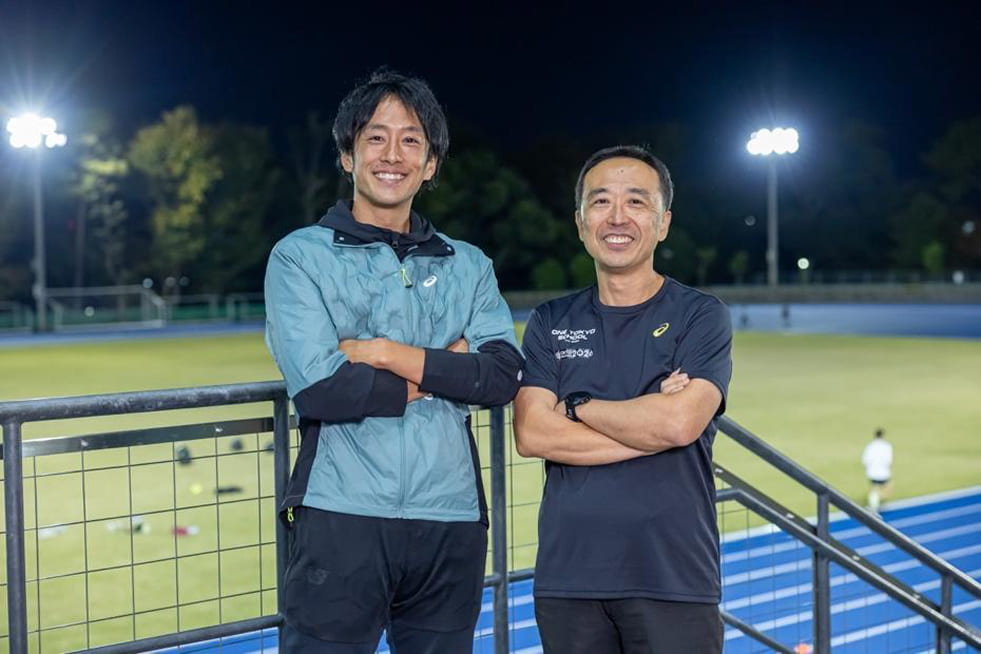
This time, we spoke with Mr. Shohei Mita, a coach at the “ONE TOKYO School,” a running clinic organized by the Tokyo Marathon Foundation’s official club, “ONE TOKYO.” We were also joined by Mr. Toshiaki Saegusa, a runner who has participated in the school for three consecutive terms. We discussed the bond between coaches and runners, the power of persistence built over time, and the appeal of the growing community fostered by the Tokyo Marathon.
Running Originally Started as a Way to Lose Weight

――Self-introduction including your running history
Saegusa: I’m Toshiaki Saegusa. I’ve been a runner for over 10 years now. The reason I started running was to lose weight. As I kept at it, I started thinking, “I’d like to try a race,” and naturally I set my sights on the Tokyo Marathon, given its status as one of the AbbottWMM. My dream came true: I ran the Tokyo Marathon as my very first full marathon, finishing in about 4.5 hours. Back then, the finish line was at Tokyo Big Sight, and that last bridge was brutal. It brings back some painful memories (laughs).
Mita: I’m Shohei Mita. I’ve been running since junior high school and even had the chance to compete in the Hakone Ekiden relay race during my university days. After that, I ran for the corporate team at Toyota Boshoku Corporation before becoming a coach. This is now my 15th year of coaching. I ran the Tokyo Marathon once during my previous job, but I tore a muscle around the 25km mark and ended up taking about 3 hours and 40 or 50 minutes. So, for me, the Tokyo Marathon brings up images of that muscle tear…
Saegusa: Sounds like neither of us has the best memories of it (laughs).
Mita: But I clearly remember how incredible the roadside cheering was, just like the Hakone Ekiden. There are voices cheering you on at every point, which keeps your motivation high. Maybe that’s why I pushed myself too hard. The power of the Tokyo Marathon’s cheering is really on another level.
Saegusa: I agree. I think that’s what makes it completely different from other races. Everyone is just roaring, cheering you on. I don’t think there’s any point where the cheering stops.
25 Training Sessions in Six Months, Plus a Guaranteed Entry for the Tokyo Marathon
――What led to the creation of the “ONE TOKYO School”?
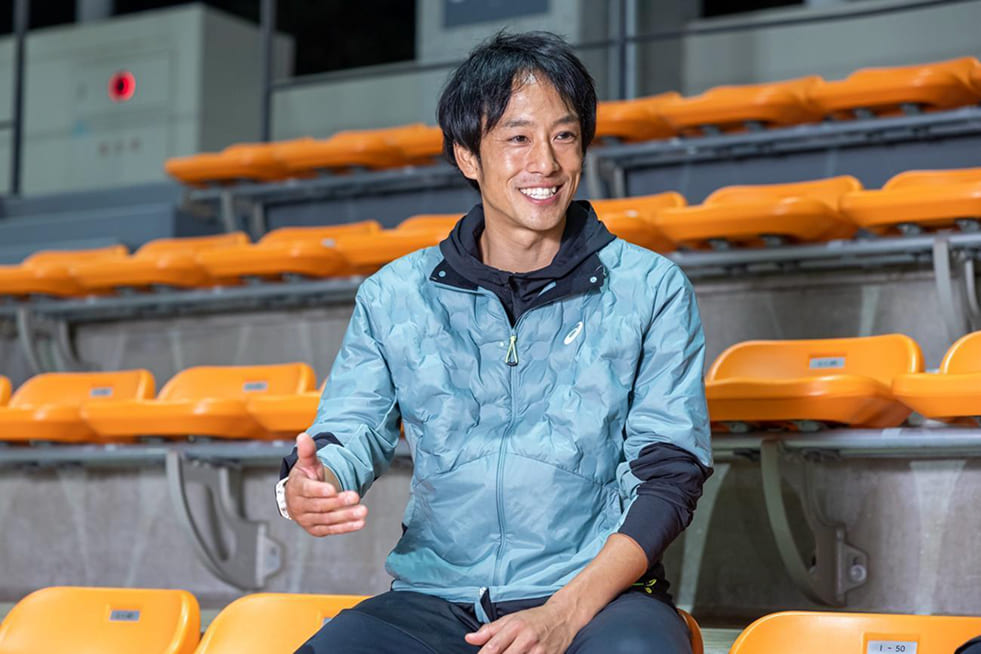
Mita: I’ve been involved with the “ONE TOKYO School” since its first term in 2024. I sensed that there were many people who “wanted to run,” and I had a strong desire to teach adult runners proper running form so they could run without getting injured. In addition to that, I’ve been involved since the launch because I wanted people to understand the importance of taking half a year to properly build up their bodies. Through my coaching, I realized there was so much that runners didn’t know, even about a single aspect like running form. I wanted to reach as many runners as possible. And after teaching them, I wanted to run the Tokyo Marathon together with them.
――The “ONE TOKYO School” members run the 42.195km with their coaches on race day?
Mita: Yes. We currently run the classes with a two-person team: a main coach and a support coach. On race day, we run in a “sandwich” formation: the main coach leads the pack based on the target time, and the support coach runs behind the members. This creates a real sense of team unity.
Saegusa: That is just incredibly helpful. They carry drinks and everything for us, and they even fan us with towels from behind (laughs). This is the third term of the “ONE TOKYO School,” and I’ve been participating since the very first term.
――Mr. Saegusa, what made you decide to join the “ONE TOKYO School”?
Saegusa: The guaranteed entry to the Tokyo Marathon, which came as a benefit, was a huge factor. Besides that, you don’t often get an opportunity to really study running, so I thought it sounded interesting and decided to join.
Mita: We have 25 training sessions over six months, but we first focus heavily on “building a foundation” before we even run. I think most people have a strong image that you get faster at marathons just by running. But in my class, before we run, we thoroughly focus on training to build the core strength that supports the body and to learn how to use the body properly.
――Do you have any first impressions or stories from when you two first met?
Mita: Oh, I remember it perfectly. Mr. Saegusa, you didn’t talk much at the beginning. Maybe you were nervous?
Saegusa: Of course! It would be weird to be chatty right from the start (laughs).
Mita: But I saw that you were someone who never gave up, even during the really tough training sessions. Your face would be crumpled in exertion, but you always pushed through to the end. I thought, “This person is a really hard worker.”
Saegusa: That’s very kind of you to say. It’s thanks to Coach Mita’s wonderful guidance that I’m able to run like this today (laughs). But joking aside, Coach Mita’s lessons are tough, but they’re fun. He doesn’t just stand there and yell, “Do this!” He does the hard workouts with us, which makes me want to push harder, and it builds a strong sense of trust.
A Shocking DNF just 600m from the Finish… Overcoming That Disappointment
――As you’ve continued to participate in the “ONE TOKYO School,” what growth or changes have you noticed in yourself?
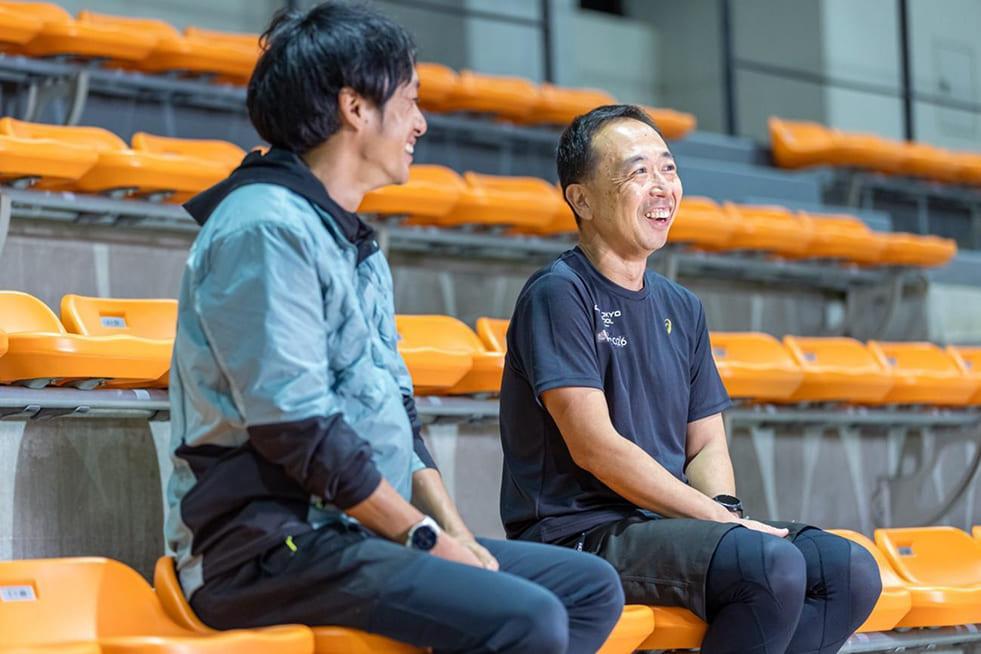
Saegusa: I feel like I’ve built up a decent amount of strength for running, but Coach Mita always says, “Not yet, not yet.” I’ve been doing this for three years, and I score only 2 out of 100, right?
Mita: Oh, but that’s not true recently. I’d say you’re at about 35 now. I have all participants start with the four-legged crawling exercise that has become my signature lesson, and Mr. Saegusa used to be gasping for air after just 5 or 10 meters.
Saegusa: Right, I couldn’t do it at all at first.
Mita: But now you can do about twice as much, and your speed at learning new training methods has also increased. I believe your physical ability to support your body has really strengthened over the past two years.
――Is there a memorable moment for either of you where you thought, “I’m so glad we did this”?
Mita: It would have to be the second term last year. When Mr. Saegusa participated in the first term the year before last, he entered the race in shape to almost certainly run a sub-4-hour marathon. But about 600 meters from the finish line, he suffered from dehydration.
Saegusa: I was carried off on a stretcher and couldn’t finish the race.
Mita: He had been maintaining a pace that would have put him at around 3 hours 55 or 56 minutes, so I was sure he was going to make it. But actually, something started to feel off around the last 5km…
Saegusa: Yes, I started feeling strange and dizzy.
Mita: It was also a scorching hot, sunny day, so although we had him hydrating frequently, I still regret that perhaps we could have done more, like having him drink even more aggressively. And of course, I regret that we had to have him withdraw just 600 meters from the finish.
Saegusa: You felt that way?
Mita: Of course! (laughs). For the second term of the following year, we were extremely careful to avoid dehydration. We had him actively take in fluids on his own and also focus on things like carb-loading the day before. He easily broke 4 hours, so I was truly relieved and happy then. Although… he did get dehydrated after he finished…
Saegusa: Exactly (wry smile). I collapsed after I crossed the finish line. So my goal for the 2026 race is “Don’t get dehydrated.” This time, my goal is to share the joy of finishing with everyone and make it all the way to the post-race party (laughs).
The Power of Connection Created by the Tokyo Marathon and the “ONE TOKYO School”
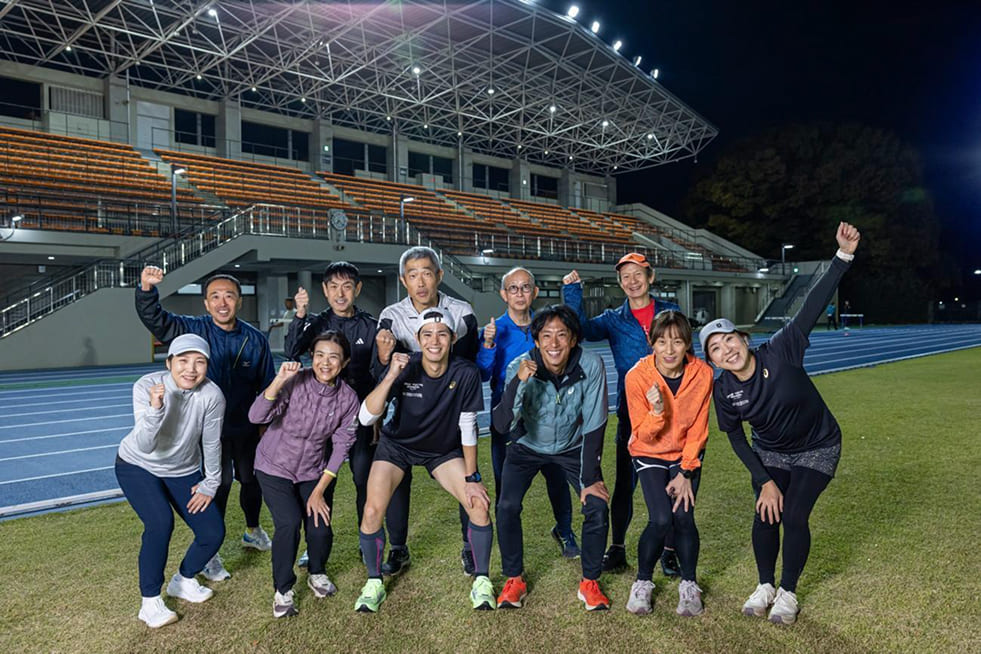
――Coach Mita, what do you find to be the main appeal and value of the “ONE TOKYO School”?
Mita: I think the biggest thing is that people get to learn things they didn’t know. As coaches, there’s so much we want to share with runners, but it’s impossible to teach it all in one day. However, by providing structured, sequential guidance—like focusing on this this week, and that next week—I believe we can significantly reduce the risk of injury. In addition, being able to support them all the way through to race day is a huge factor. We also use tools like LINE to stay in constant contact with our members, so I think that the close connection between runners and coaches is a core part of the community’s appeal.
Saegusa: The way they support you with everything is just incredibly helpful. After all, it’s very difficult to train for a marathon on your own. Having a coach nearby who is always there to support you is incredibly reassuring. My own running life has changed since I started attending the “ONE TOKYO School.” They give you thoughtful, personal advice on everything, even what to eat right before a race. For me, it’s something I’m genuinely grateful for.
――For runners aiming for the Tokyo Marathon, why is continuous support like that from the “ONE TOKYO School” so important?
Mita: I think runners who are already highly motivated are fine, but many people find it hard to go out and train without some kind of trigger. But if you have a set day once a week to meet and train as a group, I think it makes you feel, “Okay, I’m going to do my best, too!” I believe this is a very important aspect of group psychology.
Saegusa: It’s true, “doing it together” is a wonderful thing. I know I couldn’t do the same workouts if I were told to do them alone. Because we all gather and do it together, it gets my own motivation up.
Mita: At the “ONE TOKYO School,” we differentiate the sessions. Once a week, we have them do workouts that are difficult to do unless you’re in a group, or novel exercises they’ve never tried before. In the sense that we can offer a training experience you can only get here, I feel there’s real value in gathering once a week.
――How do you feel about the friendships and community you’ve gained through the “ONE TOKYO School”?
Mita: You all get along so well, don’t you?
Saegusa: We do. Everyone in this school is really friends. Even after the Tokyo Marathon is over, we invite each other, saying, “Let’s run this race together!” and participate in various events. We just went to Abashiri in Hokkaido the other day. We travel to different regional races and run together. We call it our “adult school trip.” We all have a great time running, and then we enjoy spending time with the group at the party afterward (laughs). That’s another reason I keep coming back every year.
Mita: I think it’s because everyone’s motivation for the marathon is at a very similar level, so you just click.
Saegusa: That’s definitely true. We’re all aiming for a sub-4-hour time, and our fitness levels are mostly the same, so we have a lot in common to talk about regarding training. By meeting all these different people at the “ONE TOKYO School,” my connections just keep expanding. The group of friends grows with the 1st, 2nd, and 3rd terms… It’s just really fun.
Mita: Even from my perspective, I can feel that everyone’s bond is truly strong. It’s one of my pleasures to hear their stories and “souvenirs” when they come back after traveling to a regional race as a group of six or seven.
Continuing to Build a Community Where Diverse Runners Gather

――This marks the third term for the “ONE TOKYO School.” What is your outlook for the future, starting next year?
Mita: Currently, each class trains separately, but I think it would be interesting to build a larger community that crosses those class boundaries. Of course, we already have opportunities for everyone to gather, like at time trials. Still, if we create more opportunities for interaction and connection, something even more interesting might be born. Also, our role is to be a “ONE TOKYO School” that meets the needs of a wide range of runners, from sub-3 (3 hours) to sub-6 (6 hours). I hope we can be the spark for people who want to challenge themselves with a marathon, or for those who have been training on their own but aren’t getting faster or feel they aren’t running well.
Saegusa: When I joined the first term, I was anxious too. I want to tell my past self, who was hesitating back then, to just jump in immediately. The circle of runner friends with the same aspirations has expanded, and my running life has become much richer. I always think that anyone interested in marathons should just come to the “ONE TOKYO School.” There are classes specifically for just finishing the race, so I want all kinds of people—even those who have never run before—to take on the challenge. The guaranteed entry is a huge perk, too!
Mita: Anyone having trouble with training, or who wants to understand the mechanics of running—any runner is welcome. The sub-5 and sub-6 classes have quite a few beginners. It is absolutely fine if you’ve never run before. I would be happy if people joined with the desire to train properly for six months and ran together with us.
――Finally, please give each other a message for the future.
Mita: I will do my absolute best to support you so that you can stay injury-free, avoid over-training, and deliver your best performance when it matters most. If you have even the slightest trouble or concern, please tell me anytime.
Saegusa: Yes, I look forward to continuing with you! I’m in Coach Mita’s sub-4 class, so for the Tokyo Marathon 2026, I’m going to do my best to break 4 hours—and aim for “No Dehydration” (laughs).