Interview Relay
Stories — Connected Through the Tokyo Marathon
From the Frontlines of Saving Lives: The “Spirit of Rescue” That Connected People at the Tokyo Marathon — A Story of Connection between a Professional Emergency Medical Technician Serving on the AED Bike Team and a Student Inspired to Choose a Life-Saving Career —
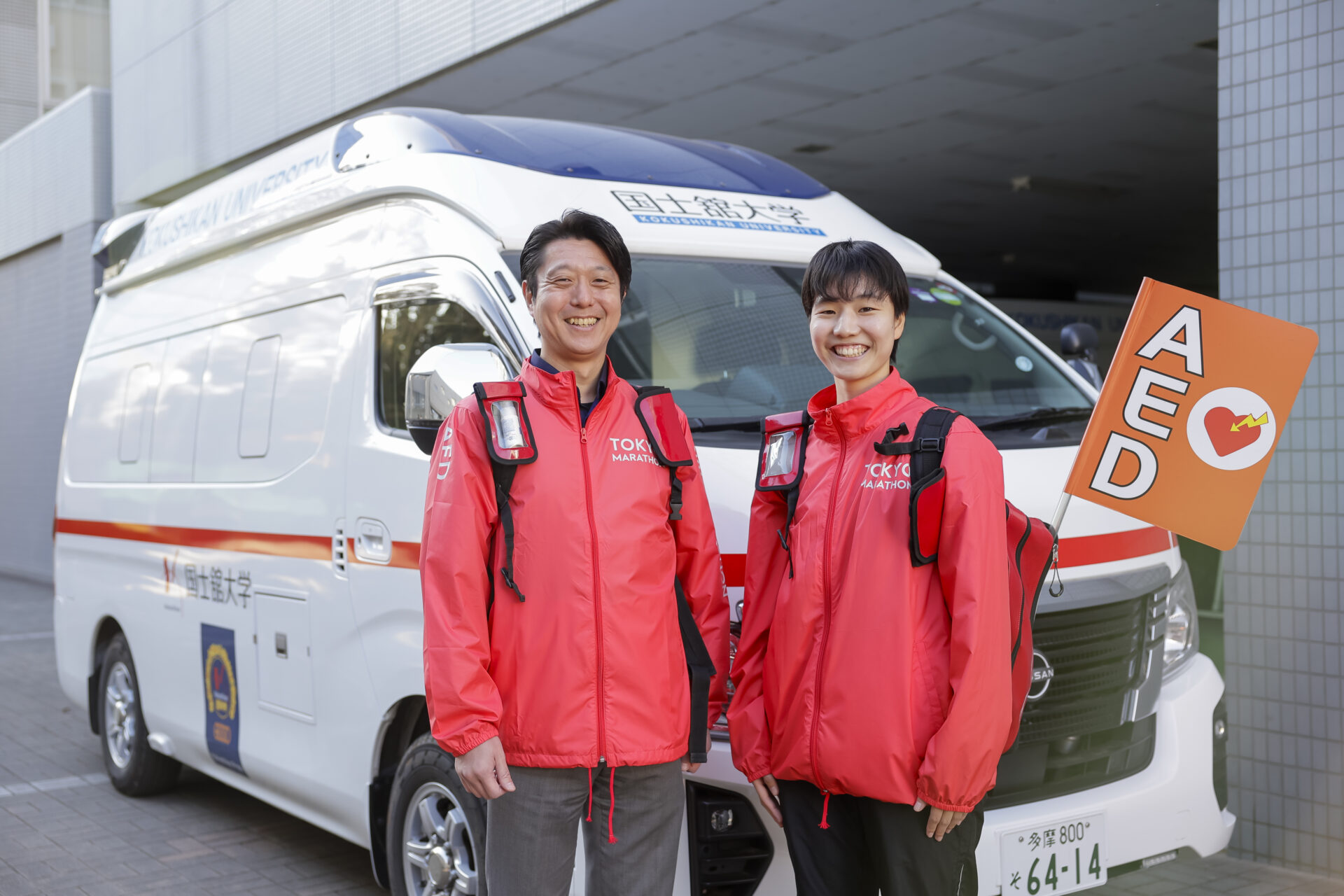
Interview Relay 2nd Run: Stories of “Connections Between People” Born Through the Tokyo Marathon.
In this interview, we spoke with Tomoya Kinoshi, Associate Professor at Kokushikan University’s Department of Sport and Medical Science, Faculty of Physical Education, who has been engaged in the establishment of the medical aid system at the Tokyo Marathon, and Riho Arihara, a fourth-year student at Kokushikan University, who has involved in the medical aid at the Tokyo Marathon and aims to become an emergency medical technician.
This is the story about the “bonds born at the medical aid site and from the mutual support”.
“AED Bike Teams” and “BLS Teams” to Protect Runners’ Lives

AED Bike Teams, Cruising around the Course, Teams of Two Healthcare Workers
――First, could you please introduce yourselves?

Kinoshi: As an Associate Professor at Kokushikan University’s Department of Sport and Medical Science, I teach students who aim to become medical technicians. It was back in 2003 when I first became involved in the medical aid for a marathon event. I was still a university student, participating in an initiative to establish a framework for how quickly we could use AEDs at the Kawaguchiko Nikkan Sports Marathon and the Tokyo City Road Race.
After that, I advanced my studies to a graduate school in 2005, conducting research and demonstrations on the establishment of a medical aid framework for a marathon event. Amid that, prior to the first Tokyo Marathon in 2007, the Tokyo Marathon made a request to Kokushikan University as to “whether students with AED could be allocated at each 1km mark”. Then I was told, “Kinoshi, go to the meeting!” (laugh). That was how I first started participating in the Tokyo Marathon. Since then, I have been providing medical aid at the Medical Aid Head Office’s Control Center for the Tokyo Marathon every year since the inaugural event.

Arihara: I am Arihara, a fourth-year student at Kokushikan University’s Department of Sport and Medical Science. I have long aimed to become a firefighter and medical technician to save people’s lives on the front lines. While searching for a target university, I learned on its website that Kokushikan University is responsible for medical aid at the Tokyo Marathon. I had never thought that a university would be involved in the medical aid for the Tokyo Marathon, and I learned that I could perform duties at the actual site, so I decided to apply for Kokushikan University. At long last, I was able to enroll in Kokushikan University, and I have been participating in the medical aid activities at the Tokyo Marathon from my first year of university to the third year. In my first year, I was in charged at the Medical Station, and on my second and third years, I was a part of the BLS Team.
Kinoshi: Like Ms. Arihara, the medical aid activities at the Tokyo Marathon are very popular among students. When we ask students at an interview for the entrance exam, “Why did you choose Kokushikan University?”, there are so many prospective students who would respond, “I want to get involved in the medical aid activity at the Tokyo Marathon. It is something I could only do at Kokushikan University”. While students of other universities do participate in a part of the medical aid activities, Kokushikan University is the only one to play a role in giving actual treatment using AEDs.

Positioned at 1km intervals along the course, BLS teams watch over runners so that they can deliver AEDs as quickly as possible.
――Could you please tell us about Kokushikan University’s “AED Bike Team” and “BLS Team,” which are unique medical aid systems at the Tokyo Marathon?
Kinoshi: The first request we received at the first Tokyo Marathon in 2007 was for the BLS Team. They wanted to have students stand with an AED at each 1km mark. In case of cardiac arrest, whether or not electric shock can be performed within three minutes makes the difference between life and death. In addition to the BLS Teams, we also proposed AED Bike Teams, which cruise around the course by bicycle, to deliver an AED as fast as possible.
This is how “AED Bike Teams,” which cruise around the course by bicycles, carrying AEDs and “BLS Teams,” which are allocated at each 1km mark on the course together with AEDs were introduced.
The Tokyo Marathon was the first event I was involved in where a runner went into cardiac arrest. The AED Bike Team was able to save the runner’s life by actually using an AED.
At present, we have a comprehensive medical aid system in place throughout the course of the Tokyo Marathon, with the AED Bike Teams – teams of two healthcare workers composed of a qualified emergency medical technician and nurse, cruising around about 1.2 to 1.5km section and coordinating medical activities in their respective sections, as well as allocating students with AED at each 1km mark. On race day, 10 people at the Medical Center, 24 AED Bike Teams (48 people in total), 40 BLS Teams (80 people in total), and about 100 people at Medical Stations are engaged in operations.
People Supporting Each Other – The Frontlines of “Connecting Lives”

――Is there anything that you keep in mind to ensure the medical aid systems run smoothly?
Kinoshi: What I always tell people is that “preparation accounts for 80%”. On race day, we must trust our teams on the ground to take the lead, but how much we can prepare in advance counts a lot. I find it very important to hash out the details in advance such as the contact system, allocation and cruising rules, confirmation of unsafe areas and identifying necessary items.
In recent years, the digital transformation has advanced, and the use of GPS and remote functions enables us to track people’s locations and on-site status in real time. Therefore, we have been able to collaborate with the on-site staff much more smoothly than before. Since last year, we have introduced an app called “RED SEAT” developed by the Japan AED Association and have been sharing the location information with our entire teams, and for the coming 2026 race, we plan to set up a system to share information with the teams involved in medical aid other than Kokushikan University.
Arihara: I have participated in the Tokyo Marathon twice with the BLS Team. In the Tokyo Marathon, there are many runners from overseas, and I myself am not so good at English, so I often faced situations where I could understand each other because of language barriers. There, I use a piece of paper, prepared by the Tokyo Marathon Foundation, on which some phrases are written in English, such as “a body part with pain” or “feeling sick,” so that we could point to such phrases to ask about symptoms, or use gestures.
Kinoshi: Is the piece of paper helpful?
Arihara: Yes, I am a heavy user, and it has been super instrumental!
――On race day of the Tokyo Marathon, were there any moments when you felt “people-to-people connections” and “connection of lives”, by collaborating and supporting with medical staff, operating staff, volunteers or runners and spectators?

Kinoshi: In the Tokyo Marathon, there is a concept “The Day We Unite.” There was an event that truly embodied the phrase.
In most races, when we are contacted that a runner passed out, AED Bike Teams and BLS Teams would head to the site and use AED. However, in the past at the Tokyo Marathon, there was a remarkable case where the AED had already been deployed by the time we arrived.
I recall that there was a case where before our teams could even get there, spectators watching nearby had already rushed to the nearest train station to retrieve an AED. By the time the AED Bike Team arrived, the heartbeat had already returned to normal.
It goes without saying that as event organizers, we have a thorough medical aid system, and beyond that, the surrounding people naturally acted to help the person who passed out. I felt “The Day We Unite.” with runners and spectators, as well as the medical staff. At the Tokyo Marathon, there are several cases in which spectators and runners perform cardiopulmonary resuscitation before we arrive.
Arihara: For me, I was particularly impressed with the event last year. While standing on the sidewalk with the BLS Team, a runner from overseas passed out in front of us. I used the piece of paper with English phrases to ask about the symptoms, but I could not communicate well, thinking “oh, I don’t know what to do,” and I was honestly stuck.
Then, a volunteer who could speak English rushed to us, and further, the AED Bike Team and a doctor runner came, and one by one, we were all connected. Initially, there was only another student and me on site, and before I knew it, we were all supported by many hands.
Centering on a sick and wounded person, I saw many people naturally connected firsthand and strongly felt that “we truly united”.
Kinoshi: I find the Tokyo Marathon a very heart-warming event, given the connections with the volunteers and spectators.
Impacts on Nation-wide Events Given by the Medical Aid System of the Tokyo Marathon, Values of Medical Aid

Twenty-four Medical Aid Stations set up on race day (actual records of the Tokyo Marathon 2025)
――From the medical aid perspective, what do you find to be the appealing points and special atmosphere of the Tokyo Marathon?
Kinoshi: One of the concepts of the Tokyo Marathon is to aim to become the “world’s safest and most secure event”. As a medical aid personnel, I strongly feel that the Tokyo Marathon actually embodies the concept, playing the role of the leading flagship of the marathon races in Japan.
Races across the nation have set up medical aid systems for the Tokyo Marathon, and I myself have received various consultation requests. At the Tokyo Marathon, we have been able to save the lives of all runners who suddenly went into cardiac arrest. With such achievements, I can be proud of the Tokyo Marathon to the world.
As a matter of fact, we now take it for granted that at many races today, we see medical aid teams carrying AEDs like AED Bike Teams, and cruising around the course by bicycle. I think it is the Tokyo Marathon that has spread such a system across the nation.
Arihara: Healthcare workers who are qualified as emergency medical technicians or nurses can only join AED Bike Teams for the Tokyo Marathon. Whereas students may operate as part of the AED Bike Teams in other races. When I operated as part of the AED Bike Team at another race, I learned so much from the healthcare workers. I have been engaging in the Tokyo Marathon as the AED Bike Team, thinking about how I could use my experiences.
BLS Teams are composed of two students who are not yet qualified healthcare workers and aim to become emergency medical technicians, so honestly, I do feel some concerns. We are often the first on the scene to make contact with a fallen runner, which carries a tremendous sense of responsibility. However, knowing that the AED Bike Teams will rush to our side the moment we need them gives me so much confidence. The collaboration system at the Tokyo Marathon is truly seamless—I’d even say it’s perfect! (laughs).
――Through these experiences, was there any change in your view towards the value of the medical aid activities?
Kinoshi: Cardiac arrest risk in runners during a marathon race is said to be about 1 in 60,000 people. Our first mission is to save the lives of such a slight probability.
On the other hand, actual cases we often encounter include leg pain and dehydration, where runners find it difficult to continue running. It is also our precious role to play in how quickly we can have such runners return to the race. However, even if a runner “wishes to run”, running the race any further can be life-threatening.
While being considerate of runners’ feelings, we must make a non-negotiable judgment regarding medical aid. How we compromise it is significantly important.
Arihara: Hands-on experience with sick and wounded people can rarely be gained through in-class education at university. I still get nervous when I interact with runners at the Tokyo Marathon, and, in addition to providing treatment, I also find communication difficult. As I accumulate such experiences, my desire to become an emergency medical technician has grown even more.
Kinoshi: Every year, we see more and more students like Ms. Arihara who are eager to volunteer for medical aid at the Tokyo Marathon. As a whole, about 600 students at Kokushikan University aim to become emergency medical technicians, and one-third of them apply for the Tokyo Marathon. AED Bike Teams have become their aspiration. We need to be qualified as emergency medical technicians, and then we can become AED Bike Teams, which is very special.
Arihara: Yes, that’s right. We, students, cannot become AED Bike Teams for the Tokyo Marathon, so we really admire them. We feel a great sense of security when they rush by bicycle, and I hope to play such a role one day.
Kinoshi: When we call for AED Bike Teams to about 3,000 former students, the positions get filled up right away on a first-come, first-served basis. This year, we received an application from Hokkaido. At the time of the inaugural race, we did not think it would be so popular. Of course, it is the power of the Tokyo Marathon brand and how we succeeded in creating a system where people want to try that makes me very happy.
The Tokyo Marathon is a Place of Learning for Active Emergency Medical Technicians and Students
――What do you think about students who desire to operate in medical aid activities at the Tokyo Marathon?
Kinoshi: All students who enter this department have a strong will to “become emergency medical technicians and save the lives of people”. Sometimes we hear “young people these days”, but when I come into contact with them in the education scene, I have a totally different impression of them. They are highly aspirational and from the bottom of their heart, they aim to become emergency medical technicians, and I feel that so much.
With a declining birth rate and fewer students, I feel grateful that there are still many young people who desire to become emergency medical technicians. In fact, the number of applicants to Kokushikan University is on the rise, and I feel the real presence of young people who are willing to pursue a profession that saves people’s lives.
For such students, the Tokyo Marathon is a significantly precious place of learning. In an ordinary demonstration session, we use a training doll for practice, but in the medical aid scene at the Tokyo Marathon, we face real people. There are so many opportunities to test the skills they have accumulated and see how applicable they are in the real world. This is why the Tokyo Marathon has become an indispensable place for students to gain experience and grow.
Arihara: I cannot help being nervous when a counterparty switches from a doll to an actual person. I have a strong will to “demonstrate what I have learned until now,” and I believe I can do it.
In my first year at university, I recorded the blood pressure of all runners who crossed the finish line at a Medical Aid Station near the finish line. It was tough work, and I kept running around, but it was truly a precious experience. By reflecting on “How can I improve to do better”, my motivation for medical aid increased further.
Kinoshi: Even for an actual emergency medical technician, it is rare to face a patient suffering immediately after a cardiac arrest and instantly provide a procedure. In most cases, we arrive on site within 10 minutes of receiving a report. From this perspective, we often hear that the Tokyo Marathon is a great place of learning for active emergency medical technicians.
――Going forward, through the medical aid activities and the Tokyo Marathon, how would you like to pass on a baton to future generations?
Kinoshi: First, I hope students proactively take on a challenge at the Tokyo Marathon as a “place of challenge” to see how applicable their daily learning is. In the future, I anticipate that students who have experienced the Tokyo Marathon will become emergency medical technicians and apply their experiences to other events across the nation.
Arihara: I have a tentative job offer from the Tokyo Fire Department, and from next year, I hope to engage in the Tokyo Marathon as a fire officer. I hope to apply the knowledge I gained as a BLS Team member next, as the fire officer.
Kinoshi: In the future, I hope to operate together with Ms. Arihara at the Medical Aid Control Center.
Message to Runners and people in the Next Generations who Aim to Engage in Medical Aid and Save Lives

――Finally, please give a message to everyone, including students and young generations who aim to engage in medical aid and life-saving operations, as well as to runners who will participate in the Tokyo Marathon.
Kinoshi: To runners: while I hope they will take on a challenge for their target, when they find someone feeling unwell, I hope that, as part of the event, they collaborate on medical aid. Just letting staff know of it is super helpful. I hope it will grow into an event where runners support each other even more. To students, I hope they will utilize the Tokyo Marathon as a place to test their ability and, in the future, return as medical aid staff.
Arihara: Not just providing a procedure, I hope to provide personalized care to each person. I hope to grow even further while considering a better way to be involved.
Kinoshi: Since this will be Ms. Arihara’s final Tokyo Marathon as a student, I hope she gives it her all and finishes with no regrets! (laughs).
Arihara: Yes, I will do my best!

Arihara has been part of the BLS medical team supporting the Tokyo Marathon for four consecutive years since her freshman year.
At Tokyo Marathon 2026, she completed her final race—with a smile that said it all.
*What we can do to save lives now
- Introduction of “Emergency Medical Aid Information” on the official website of the Tokyo Marathon –
On the Tokyo Marathon website, under the supervision of Professor Kinoshi, we offer easy-to-understand guides on life-saving skills that anyone can apply in their daily lives.
“In case of emergency, there is something that you can contribute to”.
We hope that you receive such a message from this interview.
Tokyo Marathon Official Website
The Article written by Mr. Kinoshi : Here
*The article is only Japanese.