Interview Relay
Stories — Connected Through the Tokyo Marathon
“A Bond Linked by Sky and Road”— The Support and Spirit of the Tokyo Marathon and the Japan Air Self-Defense Force Senior Non-commissioned Officer Association —
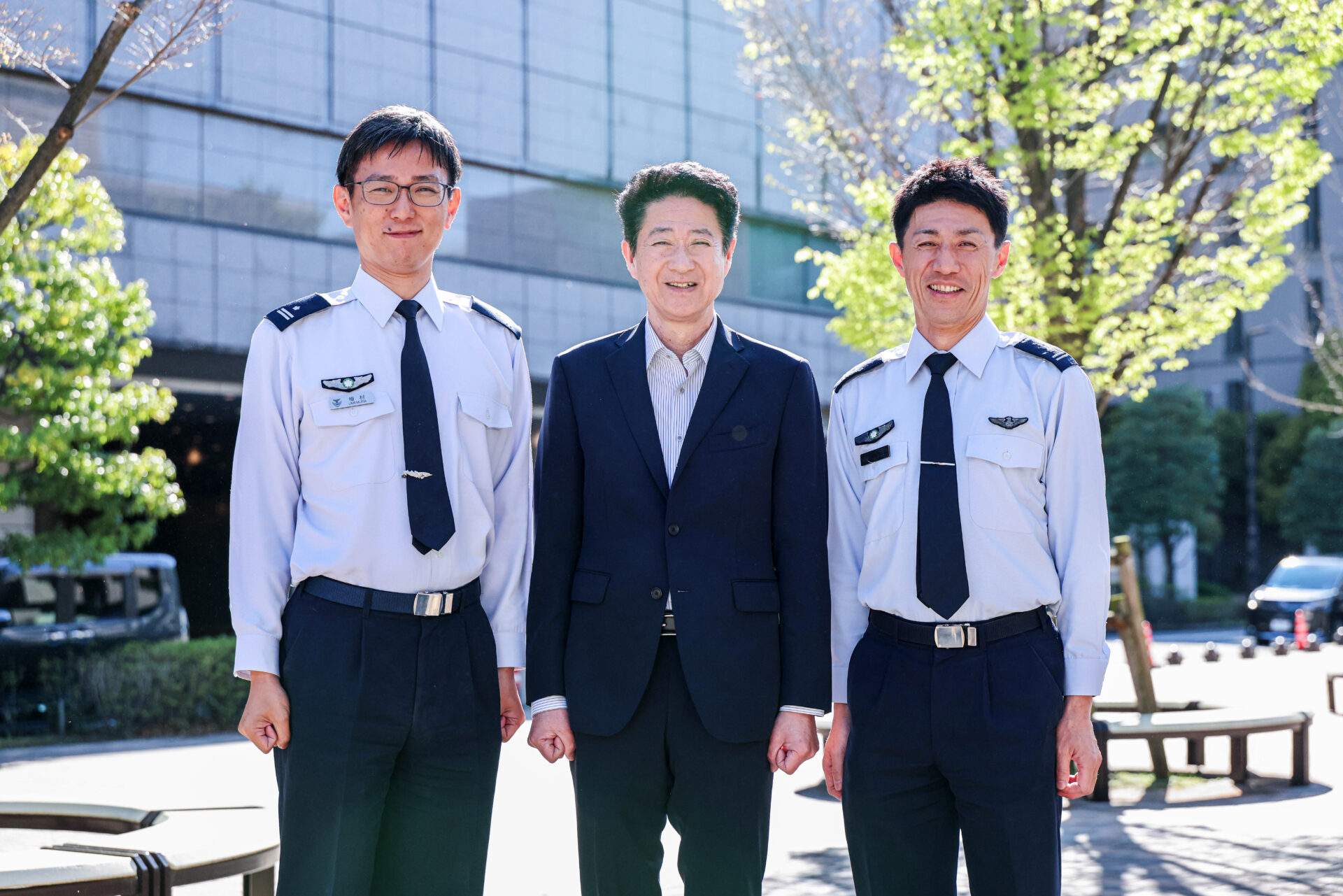
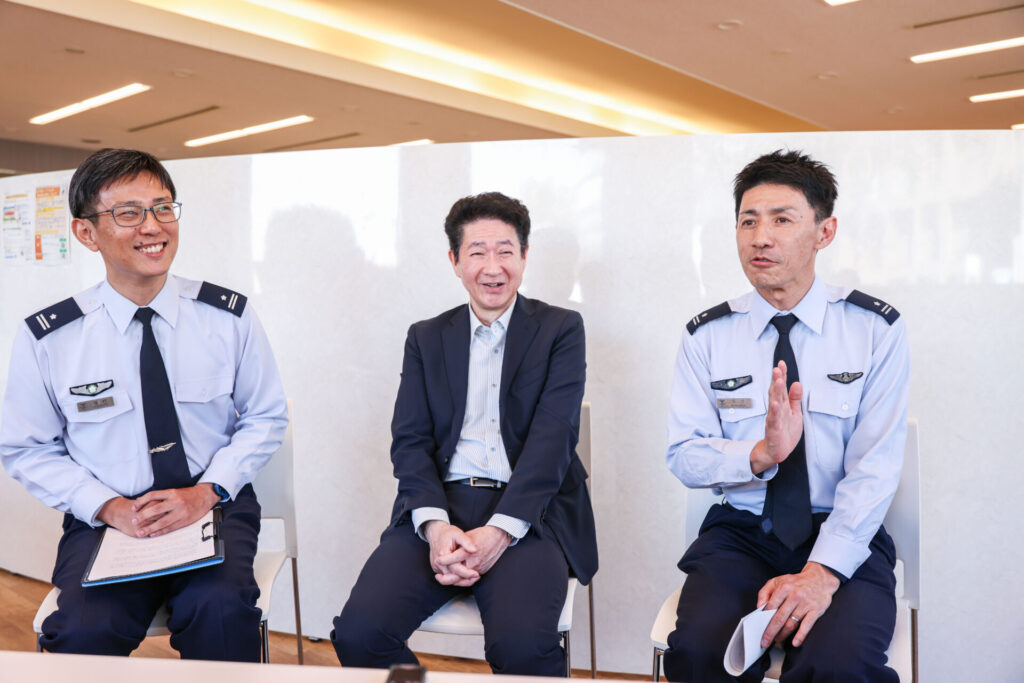
From left to right: Mr. Umemura, Mr. Sugimoto, and Mr. Hirakawa
Interview Relay 2nd Run: Stories of “Connections Between People” Born Through the Tokyo Marathon.
In 2020, when the COVID-19 pandemic prevented the race from being held in its usual format, the volunteer efforts of the Japan Air Self-Defense Force (JASDF) Senior Non-commissioned officer (NCO) Association became a vital pillar of support for the event. Since then, a deep bond of trust and cooperation has flourished between the JASDF and the Tokyo Marathon, characterized by their “supporting” role. This connection has grown significantly, encompassing the JASDF Band’s performances—a tradition that predates the pandemic—and the exciting announcement that the Blue Impulse aerobatic team will perform a flyover for the 2027 event.
For this interview, we sat down with the former chairperson of the JASDF Senior NCO Association and two active-duty officers involved with the Band and Blue Impulse. We discussed the evolving landscape of support and encouragement that emerged from the Tokyo Marathon, as well as the high expectations surrounding the upcoming Blue Impulse flight in 2027.
Hundred JASDF Officers Stepped Up Amidst the 2020 Pandemic
— To start, please introduce yourselves.
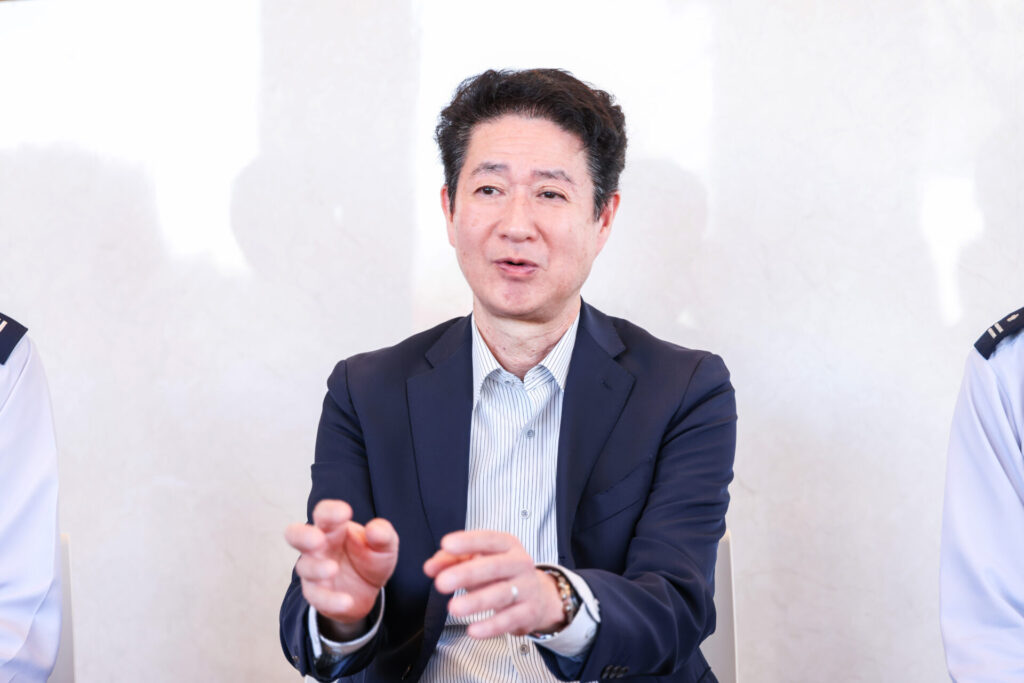
Sugimoto: My name is Takaya Sugimoto. I served as an officer in the Japan Air Self-Defense Force until three years ago. During my active-duty career, I served as the chairperson of the “JASDF Senior NCO Association,” a private organization within the force. The Senior NCO Association is dedicated to contributing to local communities across the country, primarily through volunteer work conducted outside of our official duties. This connection led us to participate in the Tokyo Marathon as volunteers, a commitment I have continued to uphold even after my retirement. I am incredibly proud that our Senior NCO Association continues to mobilize around 200 volunteers annually from various bases across the Kanto region to support the Tokyo Marathon.
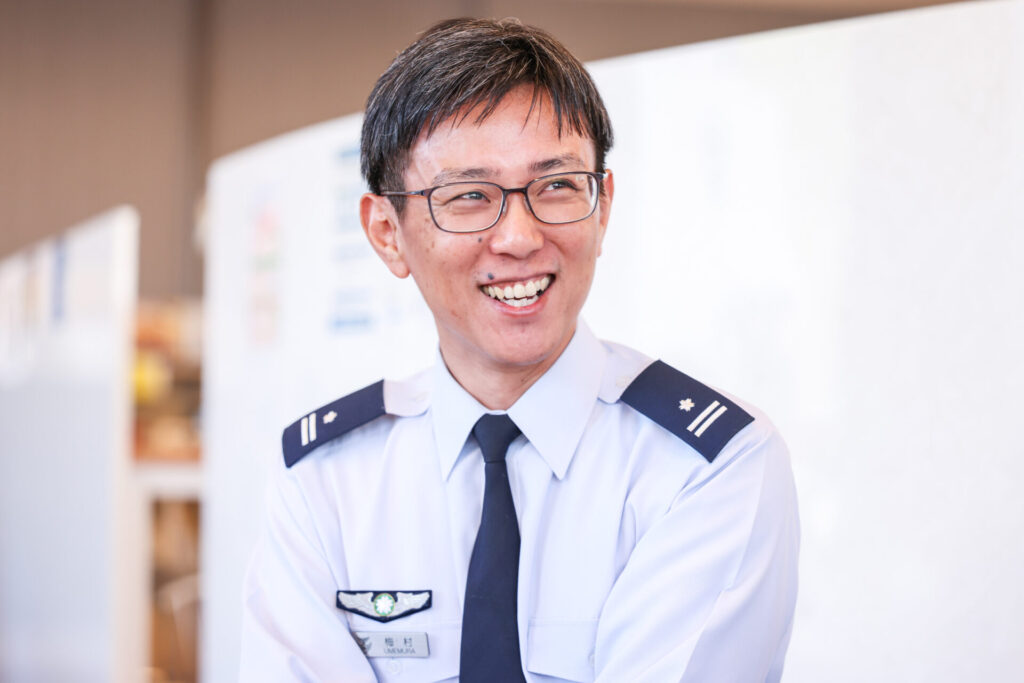
Umemura: My name is Seiichi Umemura. I am currently assigned to the Public Affairs Office of the Air Staff Office, where I am in charge of the JASDF Band. Throughout my career, I have held a variety of roles, including air weapons control officer, general affairs, and human resources.
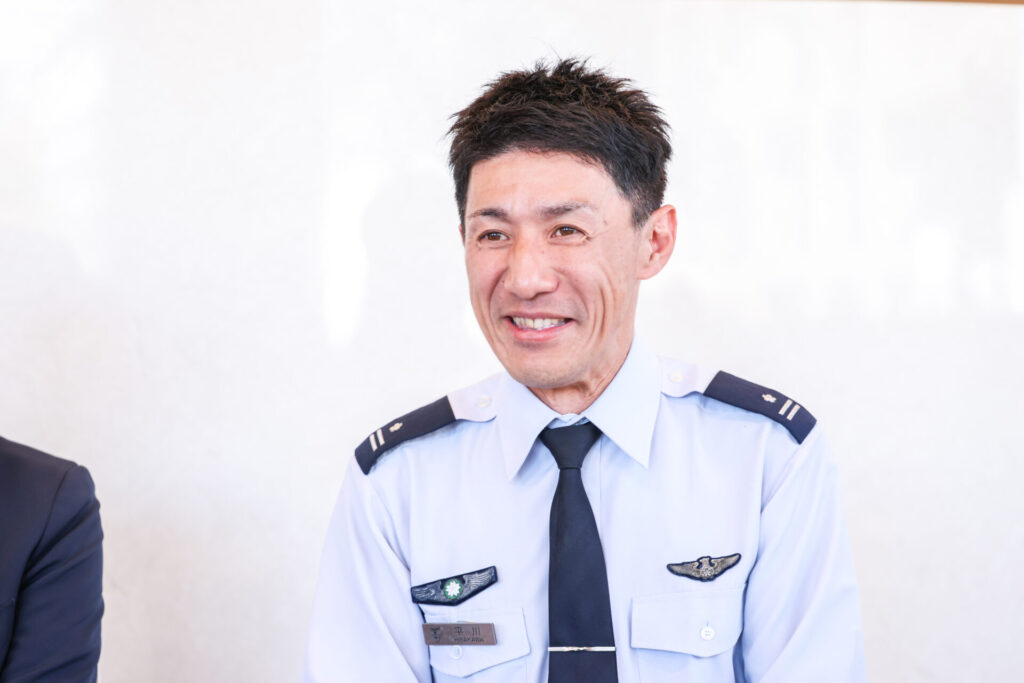
Hirakawa: I am Toru Hirakawa. I am currently responsible for the Blue Impulse within the Public Affairs Office of the Air Staff Office. I served as a fighter pilot for about 20 years, and later served as a Blue Impulse pilot from 2020 to 2023.
— Please tell us about the relationship between the Tokyo Marathon and the JASDF.
Sugimoto: In 2020, when we heard about the volunteer opportunities for the Tokyo Marathon, we registered our group. However, due to the impact of COVID-19, the general race was cancelled, and the volunteer team was initially called off. We were deeply disappointed, but then we were contacted by the Volunteer Management Division of the Tokyo Marathon Foundation, who told us, “We want to ensure the Elite and Wheelchair races are a success, and we would like your help.” After consulting with my superiors at the time, we thought about what we could do to contribute. We decided to participate with about 100 members, taking every possible precaution against infection. This experience was the catalyst for our ongoing involvement in the Tokyo Marathon. The Senior NCO Association has continued to register every year since. We primarily handle course management, operating in areas such as in front of the Ministry of Defense and Nihonbashi.
Umemura: The Tokyo Marathon has featured musical performances in front of the main gate of the Ministry of Defense by bands from the Ground, Maritime, or Air Self-Defense Forces. This initiative began with our passion to play a supporting role in the event and cheer on the runners and spectators through the power of music. Whenever the JASDF Band is scheduled to perform, our office handles the necessary coordination.
The Power of Music: Pushing Runners Forward with Live Performances
— How do you perceive the significance of the JASDF supporting the Tokyo Marathon through volunteering and the Band?
Sugimoto: This is something I have felt since my active-duty days: volunteering is one of the most effective ways for us to contribute to the local community outside of our official duties. This extends beyond sporting events to include local festivals and cleanup efforts. In depopulated areas, for example, it can be difficult to hold school events due to a lack of manpower. By engaging in these activities, I have dedicated myself to various volunteer efforts and awareness campaigns, driven by the desire to firmly root the JASDF within the local community as part of our public relations outreach.
Umemura: I believe that a large-scale event like the Tokyo Marathon is only possible because of the many ‘supporters’ working behind the scenes. The presence of those who support and cheer—like the volunteers and the Band—is part of what defines the value of the race. I truly realized this when I ran the 2026 event myself. The Ministry of Defense is located right at the 5km mark. Just as you’ve settled into your pace, the Band’s performance gives you that second wind to psych yourself up again. It is the first major point of encouragement after the start, and I felt the immense power of the Band. In fact, I actually stopped for a moment to take in the support with my whole body before running again; that is how much courage it gave me.
— Do you ever hear from the runners regarding the Band’s performance?
Umemura: Yes, the response is incredible every time. Sometimes people call out to us on the spot, and many runners wave as they go by. We’ve even received thank-you emails and phone calls after the event.
Sugimoto: It’s not just the runners, either. There are spectators who come specifically saying, “I’m here to hear the Band.” We see dedicated fans of the Band every year. I’ve personally heard those comments while working as a volunteer.
Umemura: Sound—including cheering and applause—has power, but music has a unique way of entering the heart naturally. While some runners listen to music on their headphones, the live performance of a band offers a different kind of “sound pressure” that physically pushes you from behind. It is an experience unique to a live band. I felt that power strongly myself, and I believe many other runners feel it too. If our activities help you feel a sense of familiarity with the JASDF through music, I believe that is one of the most significant aspects of what we do.
The Appeal of the Tokyo Marathon: A Runner’s Perspective
— Tell us about the Tokyo Marathon from a runner’s point of view. Both Mr. Hirakawa and Mr. Umemura participated as runners in the 2026 race—what was the experience like for you on the course?
Hirakawa: I’ve completed several marathons before, but the number of people cheering and supporting us was on a completely different level. No matter where I was on the course, the shouts of “Hang in there!” never stopped. I was amazed at how much easier it felt to run when you are lifted by so many people. There were moments when my legs started to ache and I wanted to take a break, but the power of the cheers was stronger than the pain, and it kept my spirits high. The Band’s performance was also fantastic. Hearing them play while I was in the middle of a race was a fresh and wonderful experience, quite different from how I usually hear them.
Umemura: I haven’t entered many marathons in the past, so an event of this scale was essentially a first for me. I was struck by the sight of so many people in a metropolis like Tokyo all looking in the same direction for a single event. The roadside cheering was continuous, the course was lined with iconic landmarks, and I felt as though I was being championed the entire time. Up until now, we have always been the ones providing encouragement and support, but experiencing firsthand how much joy the recipients of such support feel has changed my perspective. It made me realize that when I return to the supporting side, I want to give even more than I did before.
— Were there any other memorable moments while you were running?
Hirakawa: I believe it was around the 40km mark—I saw a female runner wearing a bright red dress and a sash that said, “I’m 60 years old!” I looked down at her feet, and she was running in sandals. She passed me like it was nothing; I felt completely defeated! (Laughs)
Umemura: We even started the race wearing Blue Impulse headgear, didn’t we? But it was much hotter than we expected, so when we reached the 5km mark in front of the Ministry of Defense, we took them off and entrusted them to the JASDF volunteers. (Laughs)
Sugimoto: Now that is what I call great teamwork! (Laughs)
Volunteering is a vital platform for human resource development
— You mentioned earlier that the pandemic was the catalyst for your involvement in volunteer activities. What were your thoughts and motivations when you first decided to participate back then?
Sugimoto: After receiving advice from my superiors, I approached the members of the Senior NCO Association with the mindset that—while this was not an official mission—volunteering at that time was akin to a disaster relief deployment. Since we were in the midst of the pandemic, we solicited volunteers on the condition that they obtained approval and permission from their families, unit commanders, and colleagues. To my great pride, I received an overwhelming amount of support, and a large number of people stepped forward to participate. I believe that volunteering is about everyone looking in the same direction and working with a shared spirit. The sense of achievement and fulfillment one feels after completing such a mission is truly immense, and I was so happy to hear so many of them say afterward, “I’m so glad I did this.”
— Having been involved continuously since the Tokyo Marathon 2020, how do you feel the relationship between the JASDF and the Tokyo Marathon has evolved?
Sugimoto: The desire to volunteer for the Tokyo Marathon is spreading rapidly within the JASDF. We set aside participation slots for each base, but the competition has become so high that some personnel unfortunately miss out. That shows just how much interest has grown. One reason is that there are very few opportunities to volunteer in the very heart of Tokyo—places like Ginza or Nihonbashi—and the chance to interact with so many people from overseas is incredibly valuable. The feedback regarding those experiences has been overwhelmingly positive.
Furthermore, the JASDF utilizes these volunteer opportunities for human resource and leadership development. By working together as fellow volunteers regardless of rank, experiences are passed down from seniors to juniors, and then to the next generation. I feel that these kinds of “connections” are being forged specifically through the Tokyo Marathon.
— What are your thoughts on the connection with the local community through the Tokyo Marathon?
Umemura: Regarding the Band, we often hear from local residents asking, “Will you be performing again this year?” There are even those who make the trip all the way to the Ministry of Defense specifically to listen to our music.
Through each of these individual reactions, I feel that our Band’s activities are serving as a bridge, helping the public feel a closer connection to the JASDF. In that sense, I believe the relationship we have built with society through the Tokyo Marathon is something we must continue to cherish for years to come.
Blue Impulse: Everyone Looking Up at the Same Sky
— Let’s talk about the Blue Impulse. Could you share your thoughts on what it was like flying over Tokyo?
Hirakawa: Our first flight over Tokyo was in 2020—a flight to express gratitude to medical workers. Following that, we flew on the opening days of both the Tokyo 2020 Olympic and Paralympic Games. While we use GPS to monitor our direction and distance, we ultimately rely on visual landmarks to fly. Major landmarks like the Tokyo Dome or Tokyo Skytree are easy to spot, but for the “Gratitude Flight,” our path took us directly over hospitals. Identifying specific hospitals tucked amidst a forest of skyscrapers was incredibly difficult. We relied heavily on GPS, but even after landing, I wasn’t 100% certain we had flown above the target hospital. It wasn’t until I saw the evening news and saw that we had flown exactly where we needed to that I truly felt a sense of relief.
On the other hand, we also wrestled with the conflict of whether we should fly at all, as our presence risked drawing crowds and creating “Three Cs” (Closed spaces, Crowded places, and Close-contact settings) during the pandemic. Despite that, we felt strongly that because it was such a difficult time, we wanted people to have a reason to look up at the same sky together.
Sugimoto: I vividly remember hearing from a relative who works at a hospital in Sumida Ward on the day of the “Gratitude Flight” for medical workers. They told me, “Everyone was moved to tears,” and “The JASDF is truly amazing.” During the Tokyo 2020 Games, which were held without spectators, many Self-Defense Force members were involved in various support roles. At that time, I was also supporting the personnel involved in national flag-raising ceremonies and the cycling road race. I felt the profound impact of the Blue Impulse then as well; it gave not only the Air Self-Defense Force members, but also the Ground and Maritime Self-Defense Force personnel, a deep sense of pride and a great boost of strength as members of the Self-Defense Forces.
Umemura: At that time, I was involved in recruitment for the Self-Defense Forces in Kokubunji, and I vividly remember people telling me how the flight helped lift their spirits. In the somber atmosphere of the pandemic, the Blue Impulse reminded everyone of the “colors” they had forgotten and encouraged them to look up at the same sky. Hearing that our flight sparked natural conversations among those watching—and helped people connect—left a lasting impression on me.
Tokyo Marathon 2027: “The Day We Unite.” on a Global Scale
— Looking toward the future, what kind of relationship do you hope to see between the JASDF and the Tokyo Marathon for the 2027 event and beyond?
Sugimoto: It’s not just the Air Self-Defense Force—there are many personnel in the Ground and Maritime Self-Defense Forces who want to volunteer as well. If possible, I’d love to see all three branches participating together. As for me, I want to keep doing this until the day I die (laughs), and I’ll keep encouraging my juniors, telling them, “Let’s do this together.”
Umemura: I believe the Self-Defense Forces can continue to stay involved in many different ways. On a personal note, I really want to experience that post-race exhilaration again—that high that makes you want to sign up for the next race immediately (laughs). From an organizational standpoint, we want to continue our involvement through the Tokyo Marathon so that the people of Tokyo and the general public feel a deeper sense of familiarity and connection with the Self-Defense Force.
— What are your expectations for the Blue Impulse flight demonstration at the Tokyo 2027 event?
Hirakawa: I hope the flight demonstration delivers inspiration and courage to everyone involved in the event—the runners, the volunteers, and the spectators cheering from the sidelines. Those managing the race might be busy with their duties right at that moment, but if they can, I hope they’ll pause for a second, look up at the same sky alongside the runners and the crowd, and start the race with their hearts as one. I want this to be the moment where we truly unite.
— Finally, do you have a message?
Sugimoto: With 39,000 runners and 10,000 volunteers, the scale of the Tokyo Marathon 2026 is truly immense. The sheer magnitude of those connections is incredible. Looking ahead to 2027, with the Blue Impulse flight demonstration scheduled, I can hardly imagine the level of unity Tokyo will experience, including all the spectators. I am certain it will be an event that delivers profound emotion, allowing runners, volunteers, and spectators to unite on a global scale. I am personally filled with excitement and anticipation, and I want to pass this spirit on to the next generation.
Umemura: We are truly delighted to be involved in the Tokyo Marathon as the JASDF, as it serves as a precious opportunity for us to build a sense of familiarity with the public. In particular, I believe that conveying our thoughts through music is a gentle and accessible way to share the mission and the “human side” of the JASDF. I hope that the 2027 race will continue to cherish the power of music, becoming an event where everyone can truly appreciate the significance of supporting one another and the vital connections between people and society.
Hirakawa: A global event like the Tokyo Marathon is built upon the support of so many people. By having the Blue Impulse perform there, I hope we can create an even stronger sense of solidarity—a race where the whole world truly unites.
— By the way, in what capacity and where would you like to be for the Tokyo Marathon 2027?
Sugimoto: For me, it has to be volunteering (Laughs).
Hirakawa: I might apply as a runner again, but since it’s so hard to win a spot, if I’m not running, I’d like to cheer from the latter half of the course. I want to support people at the point where it gets the toughest.
Umemura: I would love to use my personal experience as a runner to cheer on the participants—perhaps in front of the Ministry of Defense, or near the Tamachi turnaround point around the 35km mark, which was the toughest part of the course for me.
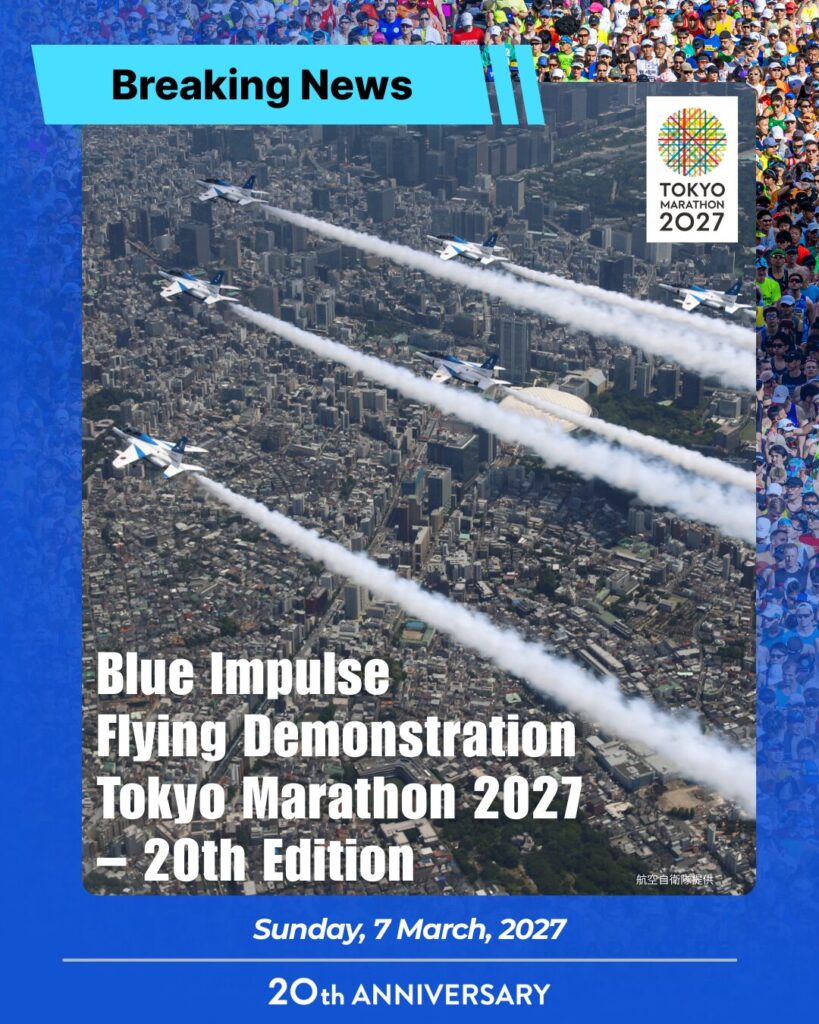
Following the conclusion of the Tokyo Marathon 2026, the Japan Air Self-Defense Force and the Tokyo Marathon Foundation announced on March 3 that a Blue Impulse flight demonstration will be conducted at the Tokyo Marathon 2027.
https://www.marathon.tokyo/en/news/detail/news_20260303145140.html